

A business owner emailed me last quarter. Eight months with another agency. No tracked leads, no conversion data, and a monthly invoice that kept showing up like a subscription nobody could cancel. He thought he’d hired a full service digital marketing agency. What he’d actually hired was a social media posting service with a fancy logo on the deck.
That’s the pattern, honestly. The phrase “full service” gets pasted on agency websites like wallpaper. Most of the time it means the agency lists everything but executes well on nothing.
So what does a real one actually do for a business that depends on leads to survive? Here’s what should be sitting behind the words on the brochure.
What “Full Service” Really Means in Practice
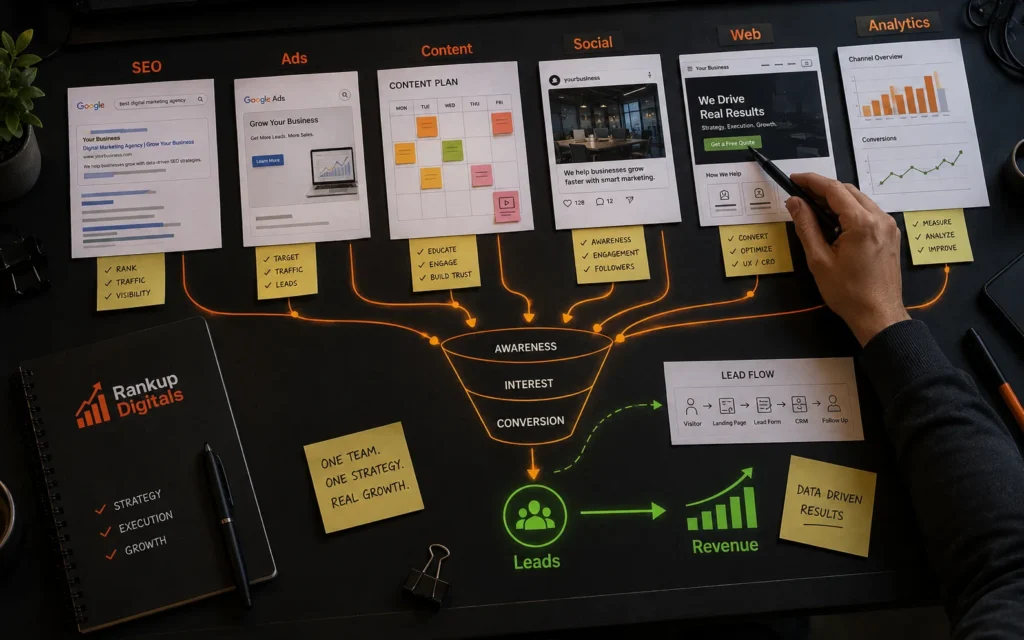
A real full service agency owns the whole funnel, not just individual channels. SEO brings in organic traffic. Paid ads fill the gaps where organic moves slowly. Content keeps the site relevant for search and trust. Social media builds the audience. Web design turns visitors into leads. Analytics ties all of it back to revenue. When one channel slows, another picks up the load.
The difference between real and fake usually shows up in coordination. The SEO team knows what the paid ads side is bidding on, so they’re not burning each other’s budget on the same keyword. The content writer knows which landing pages the PPC strategist sends traffic to. The web team builds forms that actually feed a CRM, not a black-hole inbox.
If the departments inside the agency don’t talk to each other, that’s a holding company. Not a full service team.
The Core Services a Real Agency Should Cover
Most brochures list six to ten services. SEO, paid ads, content, social, web design, email, analytics, sometimes video production. The list isn’t the answer. Plenty of agencies offer all of that and still deliver mediocre results month after month.
What matters is which services your business actually needs in the next six months, and whether the agency has proof they’ve moved the needle on those before. A small business with no traffic doesn’t need a five-channel blitz at once. They usually need solid SEO services and one paid channel running in sync. A growing ecommerce brand might need paid social and retargeting working together before another blog post even lands.
The right partner figures out where your money should actually go before pitching what they sell.
Where Pretender Agencies Quietly Fall Short
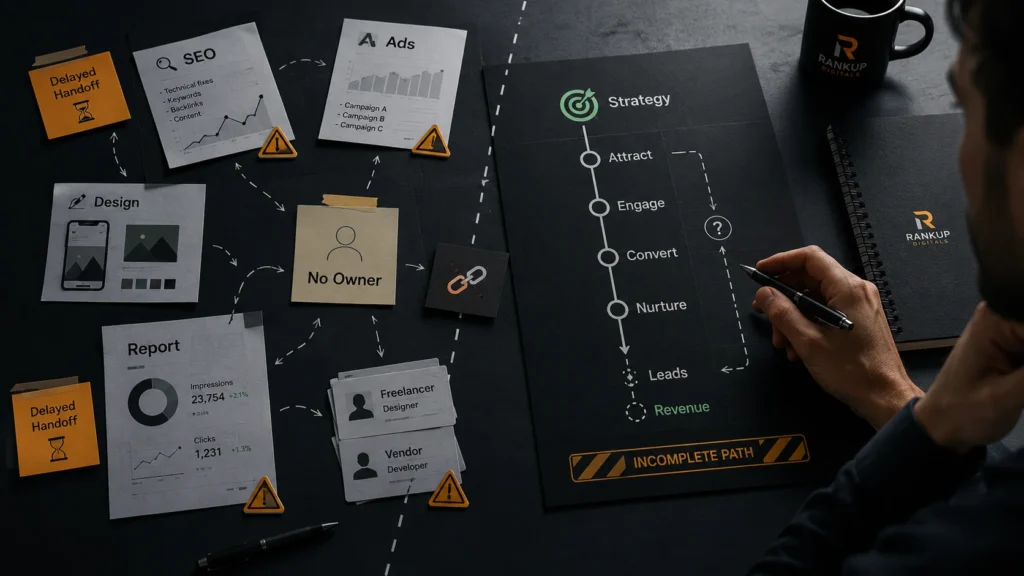
Most agencies calling themselves “full service” aren’t running every team in-house. They subcontract. The SEO goes to a freelancer in another country. The ads go to a second freelancer. The design lands with a third. By the time a brief crosses three hands, strategy gets diluted and nobody actually owns the outcome.
You can usually spot it in three ways. The reporting only shows surface metrics like impressions, post likes, or follower count, never cost per lead or ROAS. The case studies are vague or missing entirely. Getting a clear answer about who actually does the work takes a week of emails.
Subcontracting on its own isn’t the problem. Plenty of solid agencies bring in specialists when they need them. The issue is when the agency hides that the work isn’t theirs, and when nobody on the team owns whether the client wins or loses.
According to HubSpot’s marketing research, businesses that track ROI are roughly 1.6 times more likely to receive higher budgets for marketing. Real reporting isn’t a vanity exercise. It directly affects how the business funds the next quarter.
Who Benefits Most From a Full Service Digital Marketing Agency
Going full service isn’t right for every business. Some companies do better with niche specialists or a single freelancer. Others actually need an integrated team. Here’s the rough breakdown.
| Business Stage | Better With | Why It Fits |
| Startup, single-channel focus, under $1K monthly budget | Freelance specialist | One channel, one expert, full focus on the dollars you actually have |
| Established small business, multi-channel needs | Full service digital marketing agency | Channels need to coordinate, one team owns the strategy |
| Mid-size company with internal marketing lead | Niche agency for specific gaps | Strategy is in-house, you only need execution on one or two areas |
| Enterprise with in-house team | Specialist consultancy | You need senior expertise, not day-to-day execution |
A digital marketing company for small business owners almost always sits in the second row. They need leads, traffic, and a website that converts, but they don’t have a marketing director on payroll to manage three or four separate vendors. Full service makes sense because the agency essentially becomes the marketing director.
Local digital marketing usually fits here too. A roofing company, a salon, a clinic, none of them benefit from siloed agencies running disconnected campaigns. If they’re running paid ads without SEO and content backing them up, the cost per lead climbs and the ROAS stops making sense for the business.
What to Ask Before Signing Any Retainer
Three questions, in writing, before you commit to anything.
Who actually does the work, and where do they sit. Internal team, freelancer network, or a mix of both. Get names if you can. Real digital marketing experts come with track records you can verify, not just photos on an About page. When something breaks at 3pm on a Wednesday, you should know whose inbox you’re landing in, not which contact form to fill out.
How does the agency define success, and what shows up in the monthly report. You want cost per lead, ROAS, conversion rate, and a clear line between marketing spend and revenue. If they only report reach and impressions, the agency is thinking like a content creator. You wanted a business partner.
Then there’s the case studies question. Skip the “we’ve helped 500 clients” line. Ask for the specific story closest to your situation, a business at your stage, with your budget, over a real six-month window. Strong digital marketing case studies show numbers, methods, and timelines. If the agency hides behind “NDA reasons” without offering any anonymized examples, that’s a signal worth listening to.
Hiring full service isn’t a one-time decision. The retainer shows up every month, and the value either compounds over twelve months or it doesn’t. Pick someone who can explain what they’ll do, why they’ll do it, and what success looks like, in plain language you’d actually repeat to your accountant.
If you’re trying to figure out whether a full service partnership makes sense for where your business sits right now, start a project with us and we’ll walk through where your marketing budget should actually go before pitching anything.
Things Business Owners Ask Before Hiring an Agency
How much does a full service digital marketing agency cost per month?
US small business retainers typically run $2,000 to $6,000 a month, depending on which services are included. Mid-size and ecommerce brands usually sit between $5,000 and $12,000. Anything under $1,000 monthly is almost always one freelancer doing one channel, not a real full service team.
How long before results actually show up?
Paid ads start producing data inside two to four weeks. SEO usually needs three to six months to move rankings meaningfully. Real lead growth from an integrated full service strategy typically shows around the four to six month mark, not the first invoice.
Do you need to sign a long-term contract?
Most agencies prefer six to twelve month terms because marketing compounds slowly. A confident agency should still offer a shorter trial period, usually three months, with clear deliverables. Watch for vague auto-renewal clauses buried in the contract.
