
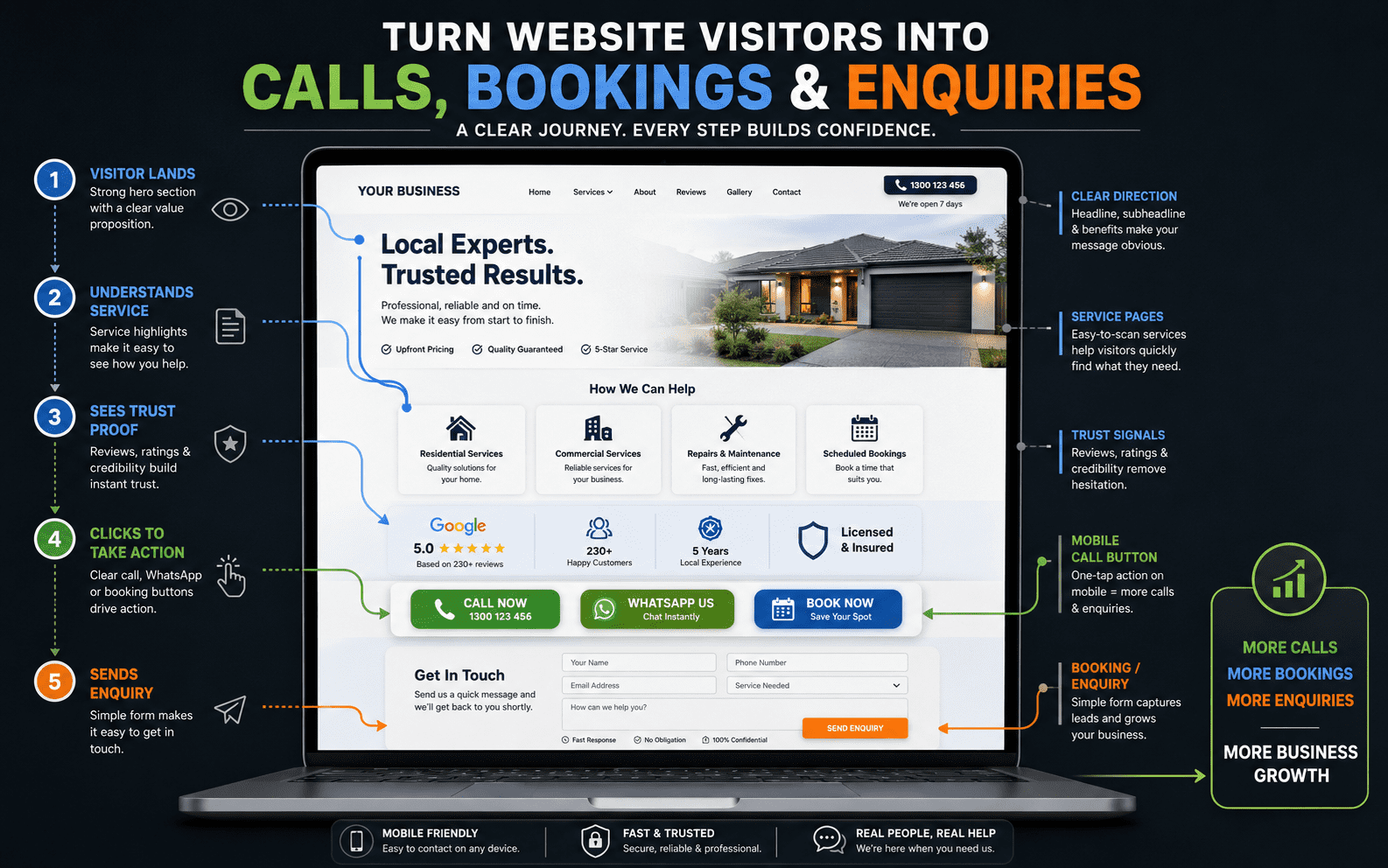
Most business owners I talk to think they need a redesign because their site looks dated.
Cleaner layout. Better colours. More premium feel. Maybe a few modern sections.
Fair enough. Sometimes the site really does look old.
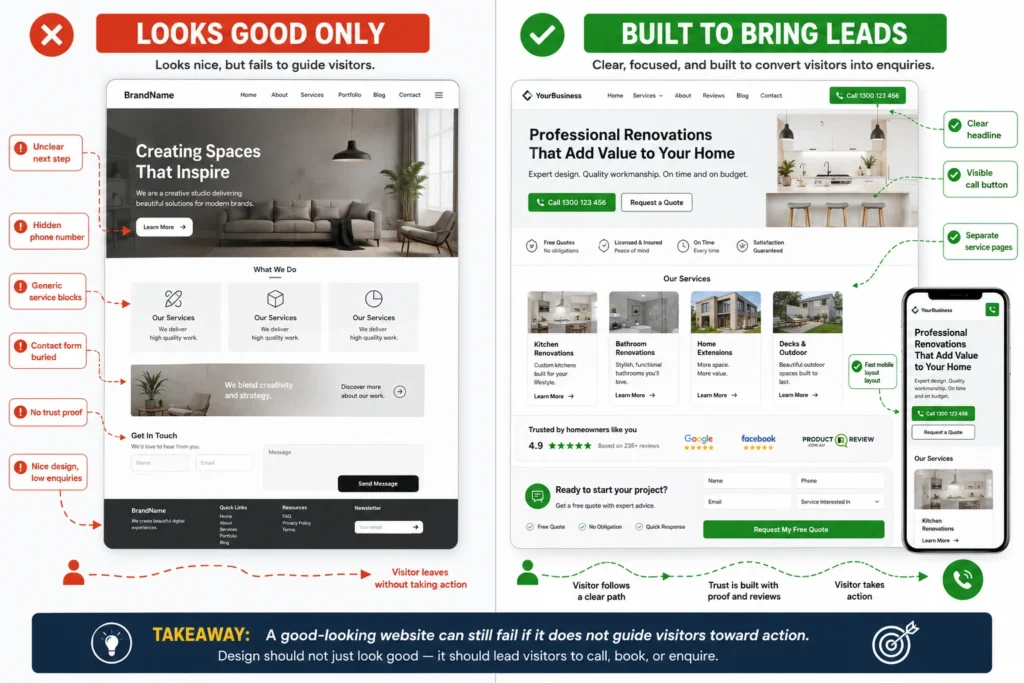
But when we audit the site, the real problem is often not the look. The site may look fine at first glance. What it lacks is direction. A visitor lands, scrolls a little, and still does not know what to do next.
Call? Enquire? Book? Read more? Compare services?
That confusion is what kills leads.
If you are searching for business website design because your existing site is not bringing in customers, this article is for you. I want to explain what a business website actually needs to do, what pages it should not skip, and why polished design alone does not fix low enquiries.
The examples come from work we do for service businesses across Oman, Qatar, Bahrain, Saudi Arabia, and Dubai, but the lesson is the same almost anywhere.
Looking Good Is the Easy Part
Getting a site to look decent is not hard anymore.
A good designer can make clean sections. Nice fonts. Better photos. Smooth spacing. The site can look professional in a screenshot.
That still does not mean it will bring calls.
The real work sits underneath the design: service pages, copy, page speed, trust signals, mobile layout, and clear next steps.
I have seen business owners spend serious money on a website and still come back months later saying, “People visit, but nobody contacts us.”
We open the site and the design is not the problem.
Usually, the problem is somewhere else.
- Missing service pages
- No clear call-to-action
- Phone number hidden on mobile
- No service area context
- Contact form buried too deep
- Copy that sounds nice but does not help the customer decide
That kind of website was built to look good. It was not built to work hard for the business.
A business website needs jobs. If those jobs are not clear before design starts, the redesign becomes decoration.
The Five Jobs a Business Website Has to Do
Before we design or rebuild a client site, I like to get clear on what the website is supposed to do.
Most service business websites have the same basic jobs.
They need to explain the service in words the customer actually uses.
They need to build trust quickly through reviews, proof, credentials, photos, or business history.
They need to make calling, messaging, booking, or enquiring easy.
They need to work properly on mobile.
They need to be structured in a way Google can understand later.
Once those jobs are clear, design has a purpose.
Without that, the designer is mostly choosing what looks good. That is how a business ends up with a nice-looking page that still does not move visitors toward action.
Here is the practical version:
| Website Element | Business Purpose |
|---|---|
| Homepage hero section | It should say who you help, where you work, and what the visitor should do next. |
| Service pages | They should show that you understand the customer’s specific need. |
| Trust strip | Reviews, logos, certifications, or proof points should reduce hesitation. |
| Call and WhatsApp buttons on mobile | These remove friction when someone is ready to contact you. |
| Local landing pages | These help capture searches like “AC repair in Doha” or “salon in Muscat.” |
A website that handles those jobs properly will usually beat a prettier website that only looks impressive.
A lot of business owners only realise this after the second redesign.
The Pages Every Business Website Should Have
A homepage is not enough.
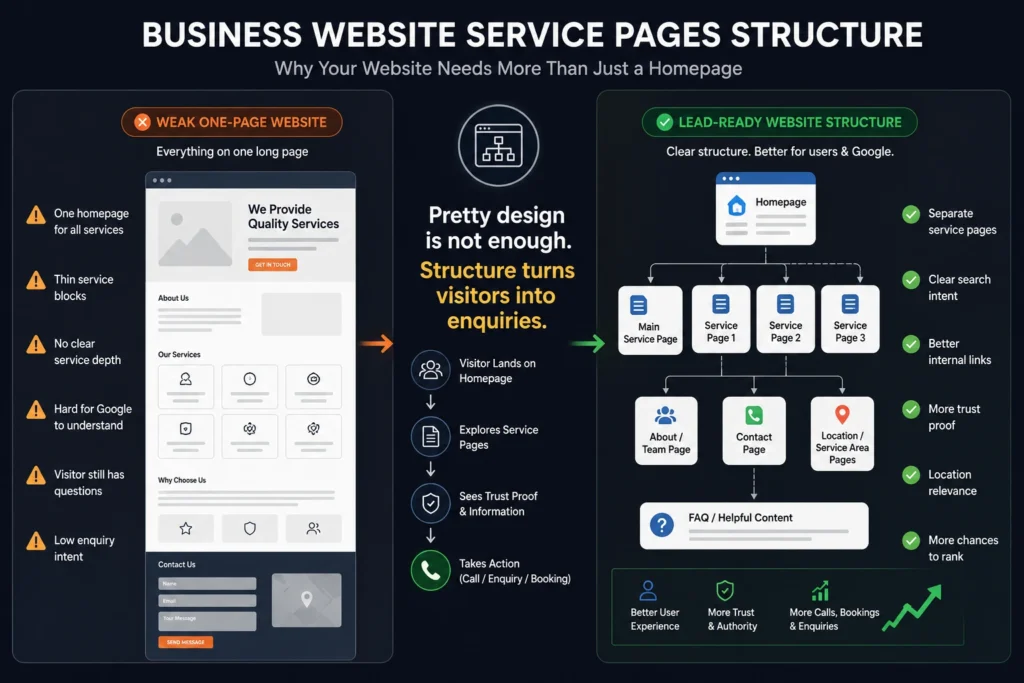
This is one of the most common problems I see on older business websites. Everything is pushed into one long homepage. Services appear in a grid. There may be a short paragraph under each one. Then a contact form at the bottom.
It looks simple, but it gives both Google and the visitor very little to work with.
Most service businesses need these pages built properly:
- A homepage that explains who you are, who you help, and what to do next
- Separate service pages for each main service
- A clear contact page with call, WhatsApp, form, email, and address where relevant
- An about or team page that shows people, experience, certifications, or business history
- Location or service-area pages if the business serves specific cities or regions
Service pages are where many websites fall short.
A single “Services” page with six short blocks is usually too thin. Each main service deserves its own page with a proper headline, customer-focused explanation, examples, common questions, and a clear action at the end.
Good content writing for service pages matters here.
Structure alone does not convert if the copy is weak.
Google’s SEO Starter Guide also talks about helpful, reliable, people-first content.
That is why thin service pages rarely help much. They do not answer enough. They do not build enough trust. They do not give Google or the customer a clear reason to care.
For businesses across the Middle East, local context matters even more. A clinic in Doha and a clinic in Riyadh may both need a website, but they do not have the same audience, expectation, or competition.
The website should reflect that in the copy and in the structure.
How Country Context Shapes the Website
What works in Muscat does not always work in Dubai.
The difference is not only culture. It is also competition, customer expectation, and how much trust the visitor needs before contacting the business.
In Oman, many local service businesses need simple, honest websites. A salon, a workshop, a small clinic, a repair company. People want to know what you do, where you are, whether you are reliable, and how quickly they can contact you.
A visible phone number, Google reviews, response time, and clear service pages can do more than heavy animations.
Qatar is different.
Clinics, consultants, real estate firms, and professional service businesses often need a more polished presence. The customer may expect the website to match the price and trust level of the service. Good photography, clear service pages, stronger copy, and visible credibility matter more.
Bahrain sits in a smaller market.
That usually means the website has to reduce friction fast. The visitor should not have to search for contact details, service areas, or what the business actually offers. A good website here should turn a Google click into an enquiry with as little confusion as possible.
Saudi Arabia needs more structure.
A business serving Riyadh, Jeddah, Dammam, or other cities should not always rely on one general page for every location. Separate city or service-area pages can help Google understand which market each page is meant for.
Dubai and the wider UAE are more competitive.
Many service categories already have strong websites fighting for attention. A generic website is easier to ignore there. The site needs sharper positioning, better landing pages, stronger trust elements, and SEO-ready structure from the start.
SEO-ready structure is something we handle inside our SEO services when the site needs to support rankings, not just look better.
Trust, Mobile, and Speed Decide the Outcome
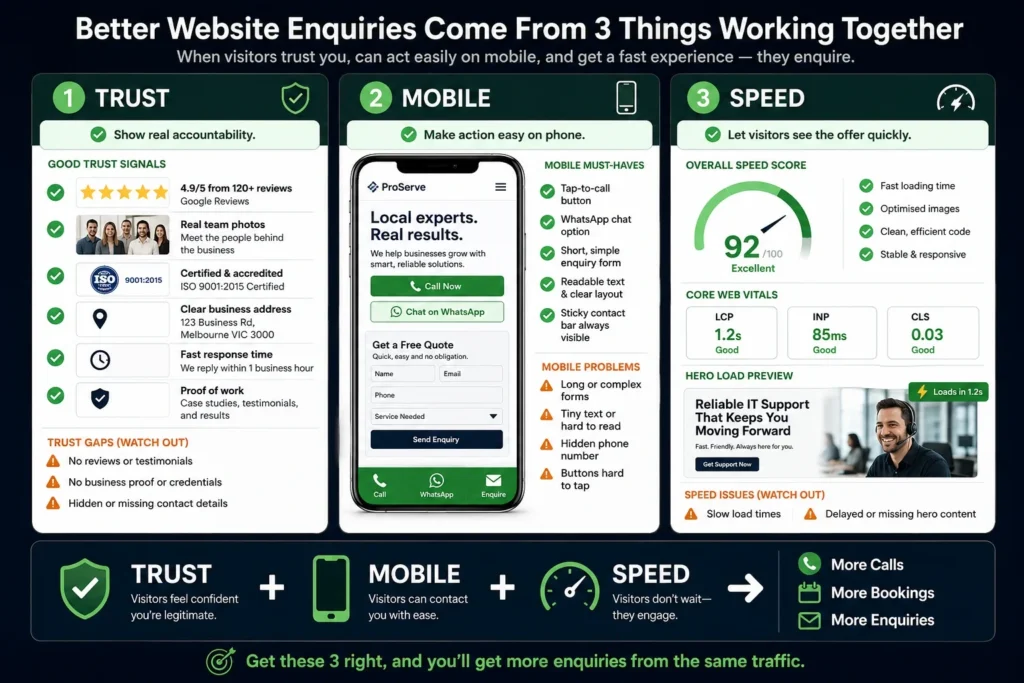
Once the structure is in place, three things decide whether the site feels serious enough to contact.
Trust comes first.
Visitors look for concrete signals: reviews from named customers, photos of the team or business, certifications where the industry requires them. A clear response time helps. So does a visible address when location is relevant to the service. The site needs to show genuine accountability behind the business, so the visitor can tell there are real people they can call and reach.
Mobile is next.
Too many business websites are still designed as desktop pages first. Then someone checks mobile at the end and hopes it is fine.
But for many customers, mobile is the main experience.
If the call button is hard to find, the form does not fit the screen, or the page loads slowly on mobile data, the visitor may leave before they even understand the offer.
Speed ties it together.
Google explains Core Web Vitals as real-world user experience metrics for loading performance, interactivity, and visual stability: Google Core Web Vitals documentation
So speed is not just a developer detail. It affects how usable the site feels.
When a site takes several seconds to load, many visitors lose patience before the offer is visible. A faster site gives them enough time to read the headline, scan the trust signals, and decide whether to call.
When Business Website Design Needs Rebuilding
A redesign makes sense when enquiries have gone flat even though traffic exists.
It also makes sense when mobile complaints keep coming back, when the codebase breaks on every WordPress update, or when every small change needs a developer to untangle old page builder problems.
A dated look alone is not always enough reason to rebuild.
For many service businesses, WordPress is still a strong CMS when it is built properly. It gives the owner control. It supports service pages, landing pages, booking forms, custom features, and SEO-friendly structure.
WordPress itself is rarely the issue. Most failures come down to how the site was built on top of it.
Our custom WordPress development is built around speed, structure, and SEO from the beginning.
If you are spending on design but not getting calls, bookings, or enquiries, the problem is probably deeper than visuals.
Start your project and we will scope it around your business goals.
Common Questions From Business Owners
Should I rebuild my existing site or just improve it?
If the current structure supports the pages you need, improvement is usually faster and cheaper.
But if the site depends on a heavy page builder, has missing service pages, breaks on mobile, or makes every small change difficult, a rebuild can be more cost-effective long term than patching the same problems again.
What pages should a business website have?
Most service businesses need a homepage, individual service pages, an about or team page, a contact page, and location or service-area pages if they serve specific cities.
The exact structure depends on the business, but one homepage with a small services grid is usually not enough.
Is WordPress good for business website design?
Yes, WordPress is still a strong choice for business websites when it is built properly.
It gives the owner control, supports service pages and landing pages, works well for SEO, and can be expanded with booking forms, ecommerce, lead forms, and custom features.
WordPress is only as good as the planning, theme, structure, speed work, and content behind it.
Does website design affect SEO?
Yes, but not only through visuals.
Website design affects SEO through page structure, internal linking, mobile experience, page speed, content layout, service pages, and how easily Google can understand what each page is about.
A good-looking site with thin pages and poor structure can still struggle to rank.
