A doctor from the U.S. came to us ready to run Google Ads.
Budget was not the issue.
That sounds like a good start, but when we checked the setup, there was no proper landing page. No treatment page built for patients. No clear appointment path. The website had a homepage, a phone number, a few service names, and that was mostly it.
He wanted ads.
What he needed first was a page that could turn a patient’s search into a call or booking.
That is where a lot of clinics lose money before the campaign even has a fair chance. Google Ads can bring the click, but the website has to do the heavier work after that.
A patient clicks and starts judging fast.
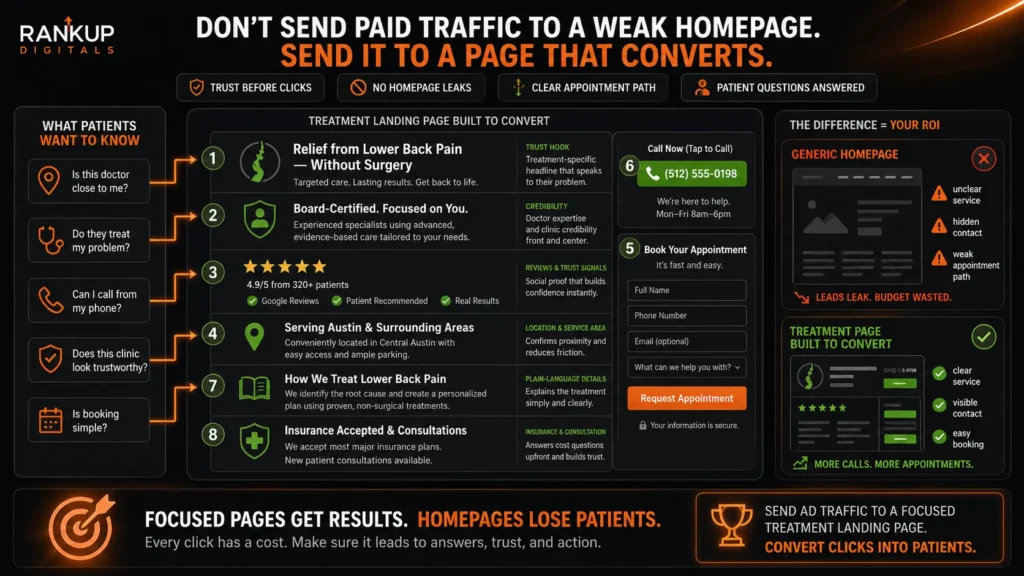
- Is this doctor close to me?
- Do they treat my problem?
- Does this clinic look trustworthy?
- Can I call from my phone?
- Is there a simple appointment form?
If the page does not answer those questions quickly, the ad spend starts leaking.
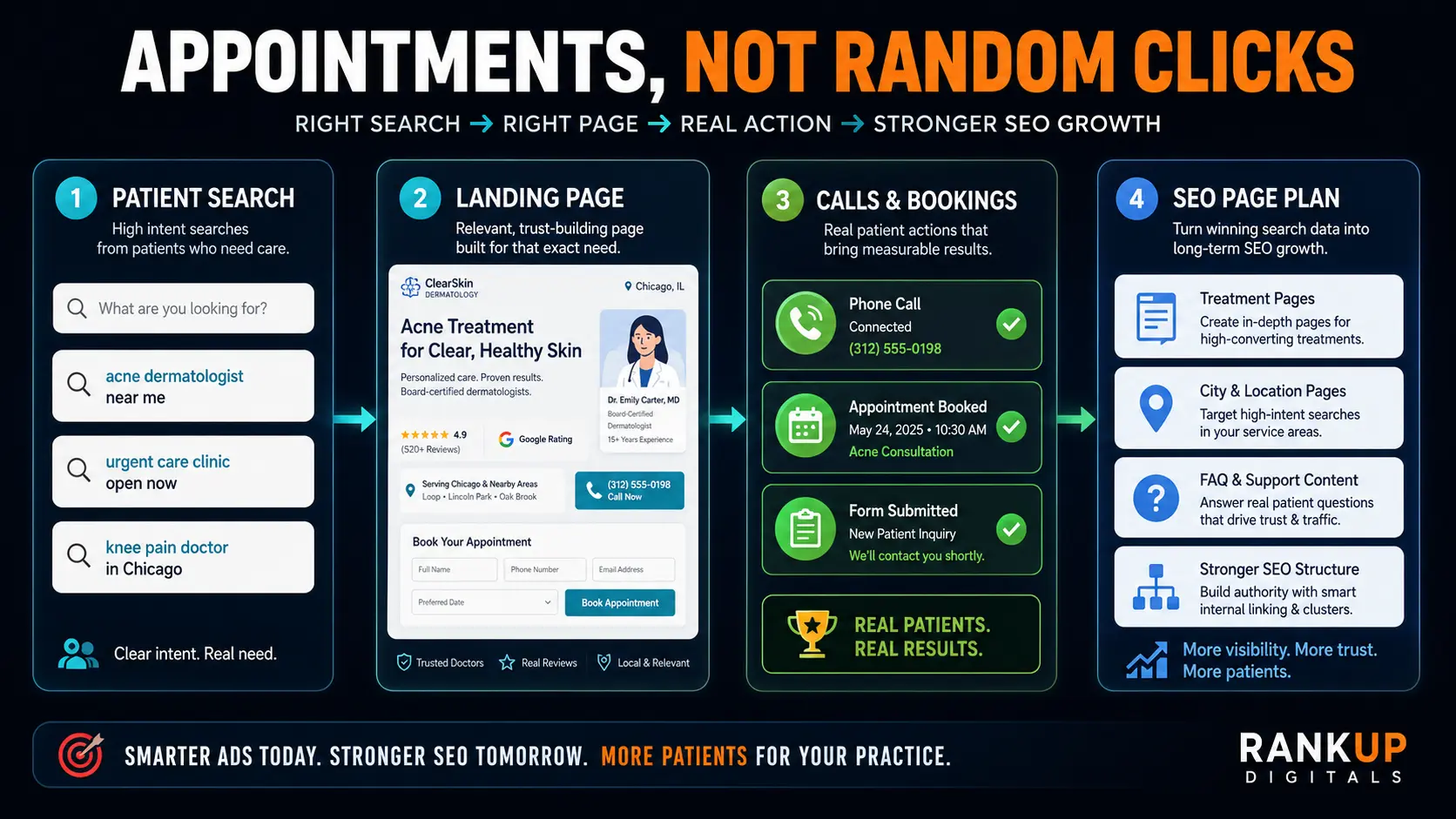
That is why a Google Ads for doctors SEO outline cannot be just “pick keywords and write ads.” For doctors, the outline has to connect the search, the ad, the landing page, the tracking, and the SEO pages you build later.
Otherwise, you are paying for traffic and hoping the website figures out the rest.
Google Ads for Doctors Starts Before the Ad Is Written
I would not open Google Ads first.
I would open the clinic website.
That tells you almost everything.
If the website has thin service pages, weak mobile layout, no clear call button, no doctor profile, no reviews, and no focused landing pages, spending money on ads will only make the weakness more expensive.
A clinic campaign is different from a normal local service campaign. Not because doctors need some secret trick. They do not.
It is different because the patient is more careful.
Someone looking for medical help is not always clicking casually. They may be worried. They may be comparing symptoms. They may need to know location, treatment details, doctor experience, insurance, appointment options, and whether the clinic feels safe enough to contact.
So when a clinic sends every ad click to the homepage, I already expect the campaign to struggle.
The homepage is usually trying to speak to everyone.
Google Ads should not do that.
If someone searches for “acne dermatologist near me,” they should land on a page about acne treatment, not a general homepage where they have to hunt through menus. If someone searches for “urgent care clinic open now,” they should not land on a page that looks like it was written for every service under the sun.
That search has intent.
The page needs to match it.
The Website Has to Earn the Patient’s Trust
A medical practice website can look clean and still fail as a Google Ads landing page.
Pretty design does not automatically create appointments.
For paid search, the page has one job: help the right patient take the next step without confusion.
That means the page should make the treatment clear, show who the doctor or clinic is, explain the location, and give the patient an easy way to call or book.
Not hidden in the footer.
Not buried behind a tiny contact link.
Right there, where the patient needs it.
For doctors, a strong landing page usually needs:
- A treatment-specific headline
- Doctor or clinic credibility
- Reviews or trust signals
- Location and service area
- Simple appointment form
- Mobile click-to-call button
- Plain-language treatment details
- Insurance, consultation, or payment details where relevant
Google also expects ad destinations to be functional, useful, and easy to navigate, which is one more reason a weak homepage is a bad place to send paid traffic. You can check Google’s own policy here: Google Ads destination requirements.
I care about this before clever ad copy.
A good ad can get the click. A weak page can waste it in five seconds.
If the clinic website is slow, thin, confusing, or not built around appointments, Google Ads will not hide that. It can expose it faster.
If the clinic needs a proper landing page or appointment-focused site structure before running ads, our WordPress development service is the part I would fix before scaling spend.
Patient Keywords Don’t Always Sound Like Doctor Keywords
Doctors and patients do not always use the same language.
That sounds small until you start building the campaign.
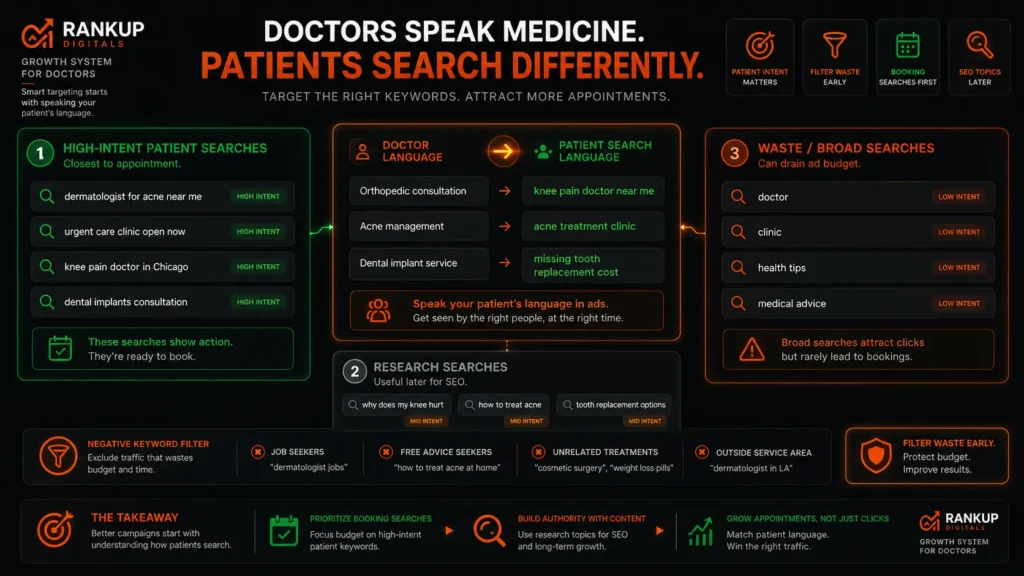
A clinic might describe a service as “orthopedic consultation.” The patient searches “knee pain doctor near me.” A dermatologist may call it “acne management.” The patient types “acne treatment clinic in Austin.” A dentist may want implant cases, but the searcher writes “missing tooth replacement cost.”
The campaign has to meet the patient where their search actually starts.
I would separate keywords into three groups before spending real budget.
First, high-intent searches. These are closest to appointments:
- “dermatologist for acne near me”
- “urgent care clinic open now”
- “knee pain doctor in Chicago”
- “dental implants consultation”
- “family doctor accepting new patients”
Second, research searches.
These can help later, especially for SEO, but I would not spend the main ad budget there at the start. Someone searching “why does my knee hurt” may become a patient. Maybe. But someone searching “knee pain doctor near me” is much closer to booking.
Third, waste.
Broad terms like “doctor,” “clinic,” “health tips,” or “medical advice” can make the account look busy while draining money. Impressions go up. Clicks come in. The clinic feels like something is happening.
Then the phone stays quiet.
That is why negative keywords matter early. If you do not want job seekers, students, free-advice searches, unrelated treatments, or people outside the service area, filter them before they eat budget.
A smaller campaign with cleaner intent usually tells you more than a big account full of noisy clicks.
The Google Ads for Doctors SEO Outline I’d Use Before Scaling
This is where the outline becomes useful.
Google Ads, the landing page, tracking, and SEO are not one big marketing blob. Each part has a job. When one part is weak, the whole system feels broken.
| Part of the System | What It Should Do | What Usually Goes Wrong |
|---|---|---|
| Google Ads | Bring high-intent local patients searching for a treatment or clinic. | Broad keywords bring random clicks that never become appointments. |
| Landing Page | Answer trust, location, treatment, and booking questions quickly. | Traffic goes to a weak homepage with no clear appointment path. |
| Call and Form Tracking | Show which keywords and pages create real patient actions. | The clinic sees clicks but cannot tell which ones created calls or bookings. |
| SEO Pages | Turn proven patient searches into long-term organic service pages. | The clinic writes generic blogs instead of building pages around treatments patients search for. |
That is how I would explain it to a clinic owner before launch.
The ad does not close the patient.
The ad earns attention.
The page builds trust.
Tracking tells us what actually happened.
SEO turns the best-performing patient searches into long-term pages that can bring traffic without paying for every click.
Once you separate those jobs, the campaign becomes easier to fix. If clicks are weak, check the keywords. If clicks are good but calls are low, check the landing page. If calls are coming but nobody knows where they came from, tracking is the problem.
You stop guessing.
You read the system.
Tracking Calls Matters More Than Watching Clicks
Clicks are easy to count.
Patients are not.
A clinic can get 300 clicks and still have no idea which keyword created a serious phone call. That is a dangerous place to be, because doctors often get real leads through calls before forms.
People want to ask about availability. Insurance. Pricing. Symptoms. Appointment timing. Whether the doctor actually treats their issue.
So before scaling a campaign, I want call tracking and form tracking in place.
Not later.
Before.
Google Ads has phone call conversion tracking for this reason. It helps show when ad interactions lead to calls, which matters for clinics where phone leads are part of the patient journey. Google explains it here: About phone call conversion tracking.
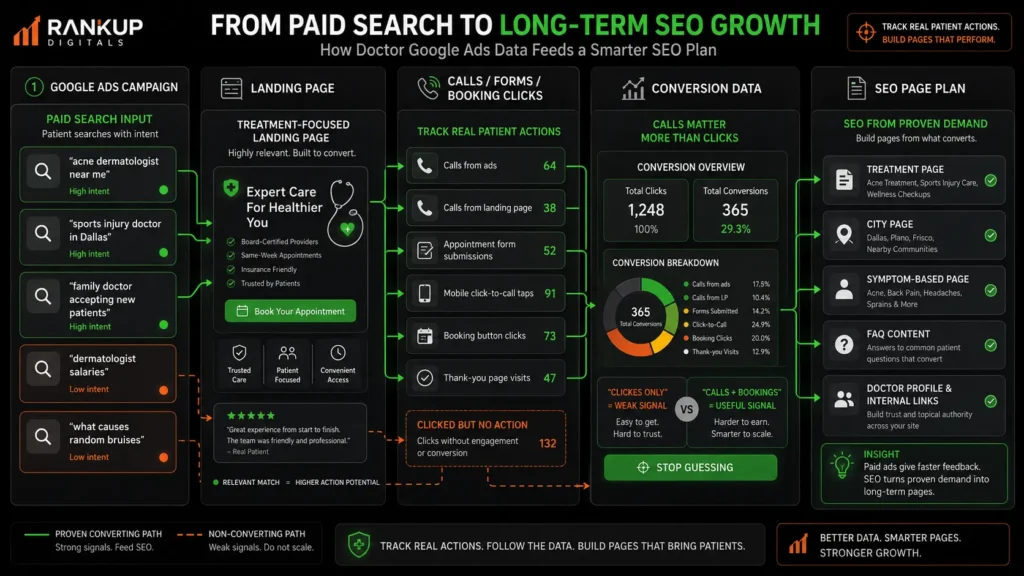
For a doctor campaign, I would usually track:
- Calls from ads
- Calls from the landing page
- Appointment form submissions
- Mobile click-to-call taps
- Booking button clicks
- Thank-you page visits
Then I would look past the number.
A ten-second call is not the same as a two-minute call. A blank form submission is not the same as a patient asking for a specific consultation. A click from outside the service area does not matter just because Google Ads counted it.
This is where the campaign starts becoming useful.
You stop asking, “How many clicks did we get?”
You start asking, “Which searches brought real patient actions?”
That one question changes the account. It changes bidding, landing pages, budget allocation, and which services deserve stronger SEO pages later.
If a clinic wants the campaign planned from keywords to conversion tracking, our Ad Marketing service is built around that kind of setup.
Paid Search Data Should Feed the SEO Plan
This is the part too many clinics miss.
Google Ads should not live in a separate corner from SEO.
If paid search shows that “acne dermatologist near me” brings strong calls, that is not only a PPC win. It is a signal that the clinic may need a proper acne treatment page for organic search too.
If “sports injury doctor in Dallas” converts better than expected, that tells you something.
If people keep searching by symptom instead of service name, that tells you something too.
Doctors often describe services in professional terms. Patients search in problem terms.
A smart campaign pays attention to both.
Paid ads give faster feedback than SEO. You can see which terms get clicks, which pages convert, which locations respond, and which services deserve more attention.
Then you use that information to build stronger long-term pages.
That may mean:
- A treatment page for each high-value service
- A city page if the clinic serves multiple locations
- A symptom-based page where patients search by problem
- FAQ content around common booking objections
- Stronger internal links between doctor profiles, treatment pages, and appointment pages
That is the useful version of the “SEO outline.”
Not keyword stuffing.
Not random blog topics.
Run ads to find patient demand. Build SEO pages around the services and searches that prove they can bring leads. Improve the website so paid and organic traffic both land somewhere useful.
When paid data starts shaping clinic service pages, the SEO strategy becomes sharper because it is based on patient behavior, not only keyword volume.
Watch the Policy Side Before You Write Medical Ads
Medical advertising needs more care than normal service ads.
You cannot write healthcare ads like you are selling shoes.
Some healthcare and medicines content is restricted by Google, and certain healthcare-related advertisers or locations may need certification. Google explains those restrictions in its Healthcare and medicines advertising policy.
That does not mean doctors should be scared of advertising.
It means the campaign needs clean wording, honest claims, and landing pages that do not promise things they should not promise.
Avoid exaggerated claims.
Avoid wording that makes patients feel personally targeted by a condition.
Avoid sending traffic to pages that are thin, confusing, or not aligned with the ad.
For doctors, trust is not only about conversion rate. It is also about how the clinic presents itself before the patient ever calls.
Mistakes That Waste Doctors’ Ad Budget
Most wasted budget does not happen because Google Ads is bad.
It happens because the setup is loose.
The common mistakes are easy to spot:
- Sending all traffic to the homepage
- Using broad keywords without enough negatives
- Mixing too many treatments in one campaign
- Running ads before the website has clear appointment paths
- Not tracking calls and forms properly
- Ignoring mobile users
- Writing ads that sound generic or overpromised
- Building SEO pages without looking at paid search data
The worst one, in my opinion, is running ads without tracking.
Because then every decision becomes a feeling.
The clinic feels like calls are coming from ads. The owner feels like one service is working. The marketer feels like the campaign needs more budget.
Feelings are not enough when money is leaving the account every day.
Final Plan Before a Clinic Spends Serious Budget
If I were setting this up for a doctor, I would not start by asking, “How much do you want to spend?”
I would start here:
- Pick the services worth advertising.
- Build landing pages that match those services.
- Write ads around patient search intent.
- Track calls, forms, and bookings from day one.
- Use the best ad data to plan SEO pages.
That is the simple version.
Not easy, but simple.
Doctors do not need random clicks. They need local patients who understand the service, trust the clinic, and know exactly what to do next.
That is what this outline is built for.
If your clinic already has the ad budget but the landing page, tracking, or SEO plan is not ready, fix that first. Otherwise, Google Ads may bring attention to the same broken path patients were already leaving.
And if you want someone to look at the full setup before money starts burning, you can start a project with Rankup Digitals and we will tell you where the patient flow is weak.
FAQs
Is Google Ads worth it for doctors?
Yes, Google Ads can work well for doctors when the campaign targets high-intent local searches and sends patients to the right landing page. It works poorly when clicks go to a weak homepage with no clear appointment path.
How much should doctors spend on Google Ads?
There is no fixed budget for every clinic. Start with a controlled test budget for the main services you want to promote, then increase spend only after call tracking, form tracking, and patient lead quality look strong.
Do doctors need a landing page for Google Ads?
Yes, in most cases. A focused landing page usually works better than a general homepage because it can match the patient’s search, explain the treatment, show trust signals, and make calling or booking easier.
How do Google Ads help SEO for doctors?
Google Ads can show which patient keywords, services, and locations bring real calls or bookings. That data can then help doctors build better SEO pages around treatments patients are already searching for.
