
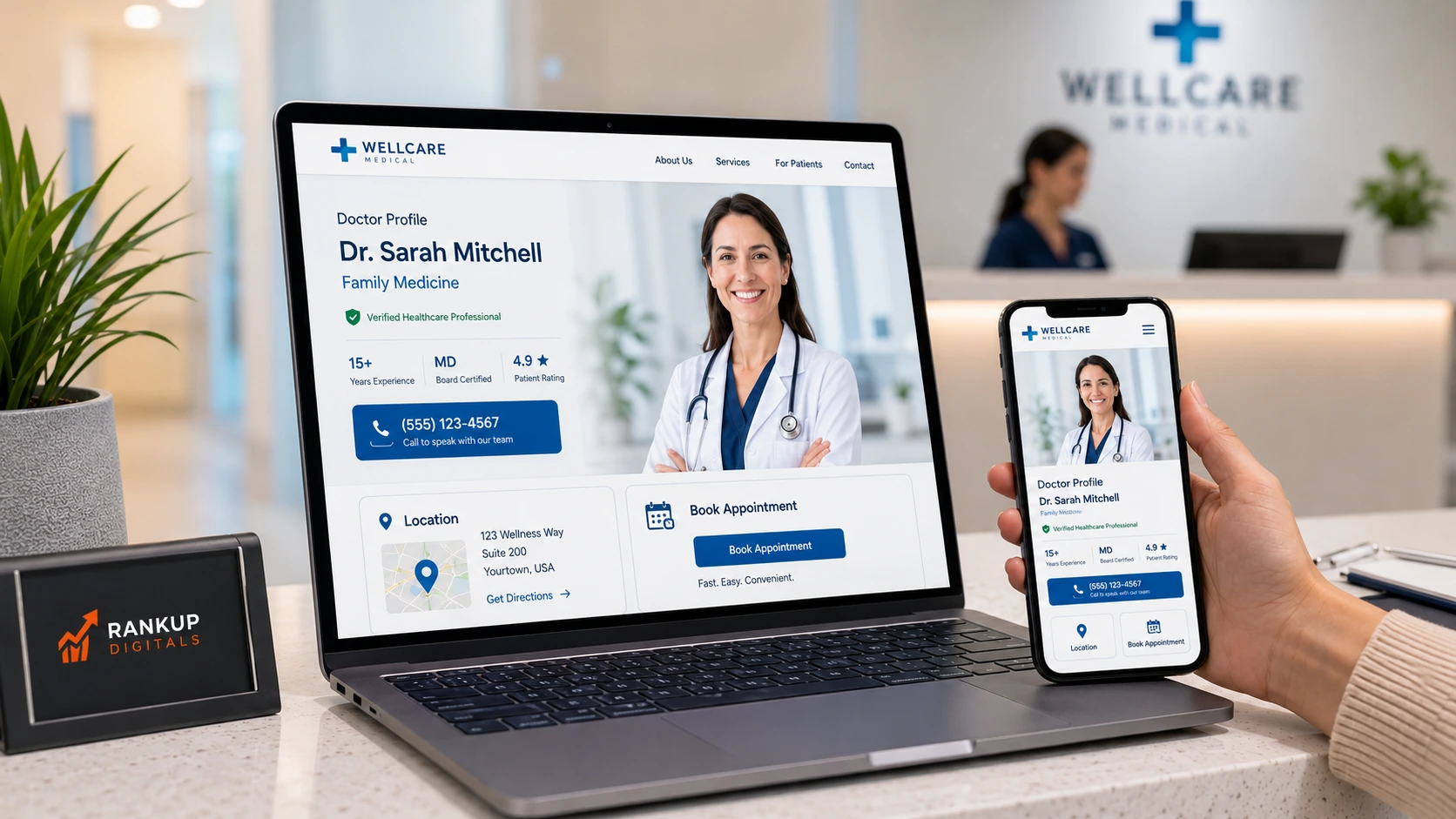
Most healthcare websites I open follow the same pattern. A polished hero photo, a calm palette, and then nothing works once you scroll past the fold.
You’ll find the contact number hidden in a footer. The booking form wants your insurance card and a paragraph about your symptoms before letting you pick a time. Their “About Dr. Smith” page reads like a generic HR template. Real estate listings have more personality than most clinic homepages.
Patients aren’t shopping for design. They’re checking if you’re qualified, reachable, and bookable in under ninety seconds. If your site fails that check, they’re already googling the next clinic. Healthcare website design lives or dies on that test.
Here’s what works.
What makes healthcare different
A clinic site isn’t a SaaS landing page. Patients land on it anxious, possibly in pain, and they’re comparing you against four other providers in one browser session.
That changes the math entirely.
What gets verified first: are you qualified, can I reach you, can I book without phoning at 2pm on a Wednesday. Three boxes. Tick all three or lose the appointment.
Practice type changes the emphasis though.
| Practice | Trust signals patients look for | Booking pattern |
| GP / family doctor | Board certs, hospital affiliation, languages spoken | Online slot picker with insurance step |
| Dentist | Procedure photos, transparent pricing, before/after work | Service-first booking (cleaning vs implant vs cosmetic) |
| Therapist | Privacy emphasis, session format, niche specialisation | Confidential intake form, simple calendar |
| Multi-provider clinic | Provider directory, hours per location, walk-in info | Provider-specific or service-specific |
Doctor website design, dentist website design, and website design for therapists share the same fundamentals but emphasise different things. A dentist hiding their pricing loses bookings just as a therapist without strong privacy language does. The root cause stays consistent: friction blocking the booking decision.
The trust stuff most sites get wrong
Real photos. Always.
You’d think this would be obvious by 2026 but most healthcare sites I audit are still running stock images. Patients clock it instantly. Generic doctor with perfect teeth, professional stethoscope, professional smile. It works against you.
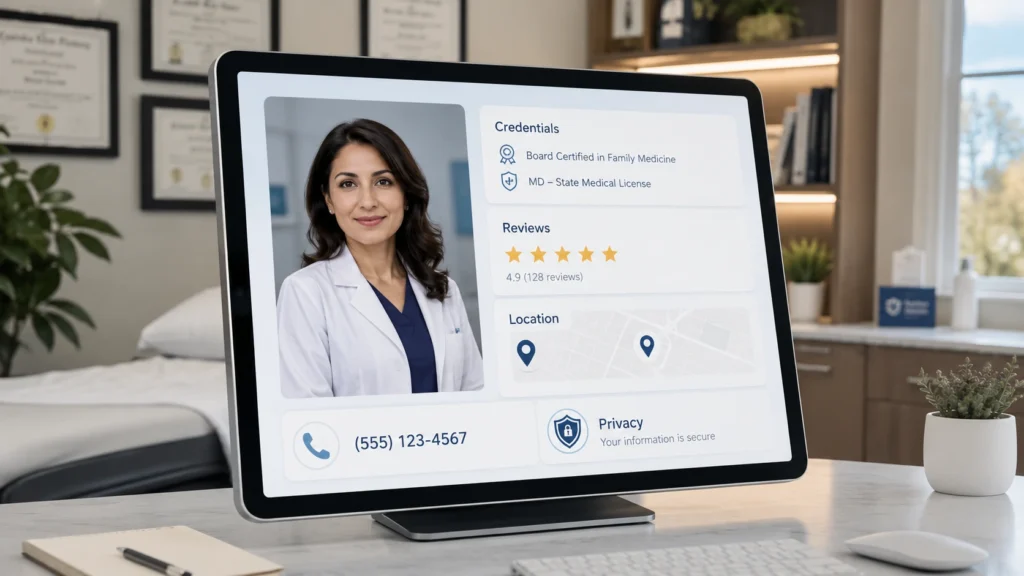
The trust pieces that move bookings:
- Names, faces, and credentials spelled out clearly for each provider
- Reviews from Google embedded live, not screenshot quotes
- Contact info visible from every page, not buried under /contact
- A working Google Maps embed, not a static screenshot
- A privacy policy a patient could understand in two minutes
Most medical website design templates skip this. Generic small-business templates with one About page, one Services page, one Contact page. Healthcare needs more layers: dedicated bios, service-specific pages, resource content, and a reviews section. Each piece carries weight.
Booking: the whole game
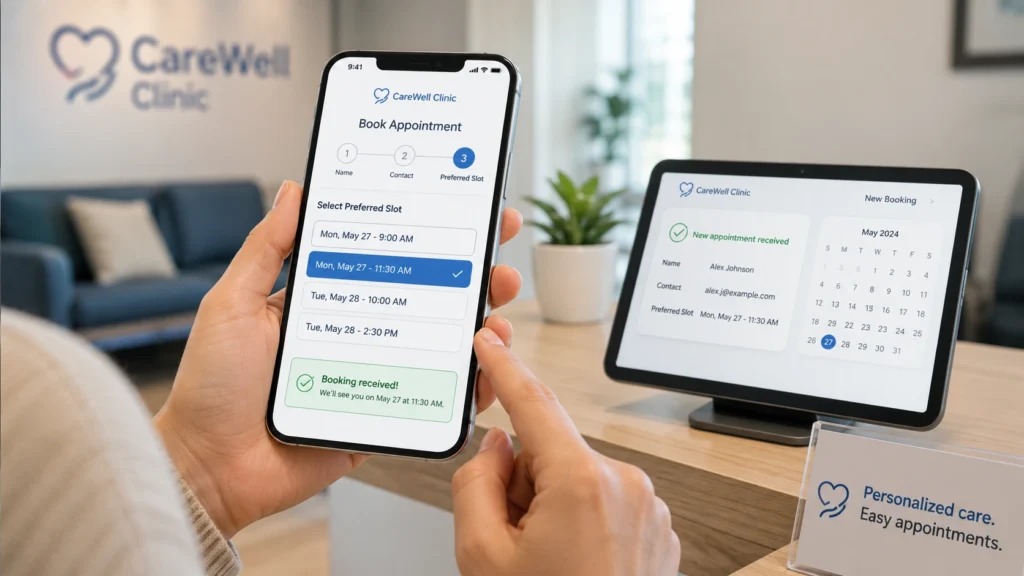
Patient appointment booking is the single biggest conversion lever on a healthcare site. Get this right and a small practice can outperform much bigger, prettier competitors. If it’s broken, nothing else on the site matters enough to make up for it.
The mistake I see most: forms asking for eight fields before letting you pick a slot. Three drop-downs. A “how did you hear about us” question. By field five the patient bounces. A working online appointment form is name, contact, preferred slot. Done. Insurance, medical intake, and reason for visit happen after the slot is held, not before.
Integration matters as much as form design. The submission has to land somewhere useful. If it dies in someone’s Outlook inbox checked once daily, you’re losing patients. The form should hit the practice calendar directly or fire off an immediate confirmation. Online booking lifts conversion meaningfully versus phone-only setups, especially with younger patient demographics.
Mobile and local SEO
Most healthcare searches are mobile now. Has been for years.
Quick mobile checklist for clinic websites:
- Site loads under three seconds on 4G
- Phone number is tappable from every page (proper tel: link)
- Booking form usable without pinch-zooming
- Map opens in the native maps app, not a 200kb embedded preview
The local SEO half. A clinic chasing “dentist Marina Dubai” needs Google Business Profile sorted, accurate location schema, citations across local directories, and content that mentions the actual service area. Skip any of these and the local pack stays closed regardless of how good your site looks.
Healthcare SEO is technical and content combined. SEO services for clinics usually involve Google Business Profile optimisation, citation cleanup, schema markup, and topic clusters built around the conditions or procedures the practice handles.

YMYL, privacy, accessibility
Google calls medical sites YMYL, which stands for Your Money Your Life. The bar for accuracy, authorship, and trust sits higher than most industries.
Privacy comes first. Any form taking patient details needs a privacy policy explaining what’s stored, where, and for how long. US clinics deal with HIPAA, UK practices with GDPR, and the Middle East has its own evolving frameworks. The policy itself should read like a human wrote it, not a legal template generator.
Accessibility is the part most sites skip and most readers don’t notice until they need it. The W3C accessibility guidelines lay out the standards: colour contrast, screen reader compatibility, keyboard navigation, alt text on diagnostic images. Bonus side effect: accessibility correlates with better rankings.
Content quality follows the same thinking. Google’s helpful content guidance wants named authors, real expertise, current information, and evidence behind claims. Practices that publish patient-facing content under their actual providers build authority faster than those farming generic blog posts.
Service pages, where most sites lose ground
Most medical website design mistakes happen on service pages.
The default pattern is one Services page listing every procedure in two-line bullets. Index-style, tidy-looking, and ranks for nothing.
Each major service needs its own page covering what the procedure involves, who’s a candidate, what recovery looks like, pricing where it makes sense to publish, FAQs specific to that treatment, and patient resources where useful.
A clinic website design with five deep service pages outranks one with twenty shallow ones, every time.
Healthcare website development at this depth usually means custom WordPress development, not the cheapest local agency throwing together an Elementor page. Templates set up by generalists carry generic boilerplate, missing schema, and structures that don’t scale past three services. Custom builds avoid that.
Final word
Healthcare website design is mostly about removing friction: real photos, contact info above the fold, booking that takes ninety seconds, mobile that just works, service pages with substance, and trust signals everywhere a patient looks.
Practices that nail the fundamentals don’t need flashy design to outperform competitors.
If your current site is missing more than two of these, the start project page is the easiest place to begin.
FAQs
What makes healthcare website design different from regular business sites?
Higher stakes. Patients are evaluating you as a medical decision, not a vendor decision. Trust signals matter more, design matters less, and Google holds medical content to a stricter quality bar through its YMYL category.
How much does mobile matter for clinic websites?
A lot. Most healthcare searches are mobile. If your site is slow, hard to tap, or makes booking painful on a phone, those patients book elsewhere.
Can a small clinic skip the privacy compliance stuff?
No. HIPAA in the US, GDPR in the UK, and similar frameworks across the Middle East. Patient data triggers regulation regardless of clinic size. The privacy policy should be specific to your practice, not a copy-paste from a template generator.
