
A contractor called me last month after paying $400 for a website. Five pages, a logo on top, a contact form that broke on mobile, and zero structure for the service areas he actually worked in. He thought he’d bought a website. What he’d actually bought was a brochure nobody was going to find on Google.
This happens almost every week. Business owners look at website design packages by price first, see two numbers, one cheap and one expensive, and assume the difference is just “fancier design.” It usually isn’t. The real difference is whether the site can do work for the business: rank, convert, scale, and not break every time a plugin updates.
If you’re about to buy a package, here’s what’s actually worth paying for, and where most cheap ones quietly fall apart.
What Should Be Inside a Real Website Design Package
The word “package” doesn’t mean anything by itself. Two agencies can sell you “5 pages, responsive, SEO friendly” and deliver completely different things.
A proper business website package should include:
- A clean custom layout, not a recycled template the agency sells to 200 other clients
- Mobile-first responsive design, tested on real devices and not just a browser resize
- Real on-page SEO setup: title tags, meta descriptions, heading hierarchy, schema where it makes sense
- Page speed work: optimized images, caching, no plugin bloat
- A working contact or quote form that sends to a real inbox, not a black hole
- Google Analytics and Search Console connected from day one
- Edit access for the owner, not a locked builder the agency controls
That last one matters more than people think. I’ve seen WordPress website packages sold where the client couldn’t even change a phone number without paying $50. That’s not a website. That’s rent.
The agency should also tell you what’s not included. Hosting, domain, content writing, ongoing SEO, monthly maintenance, these are usually separate. If a quote lumps everything together without breaking it out, ask for the breakdown before you sign anything. Vague invoices hide vague work.
Where Cheap Website Design Packages Quietly Fail
Cheap doesn’t usually fail in the way people expect. The site launches. It looks fine on the agency’s laptop. The owner pays, says thanks, and moves on. The failure shows up three months later when no leads are coming in and the owner can’t figure out why.
Here’s where I’ve watched it break, again and again:
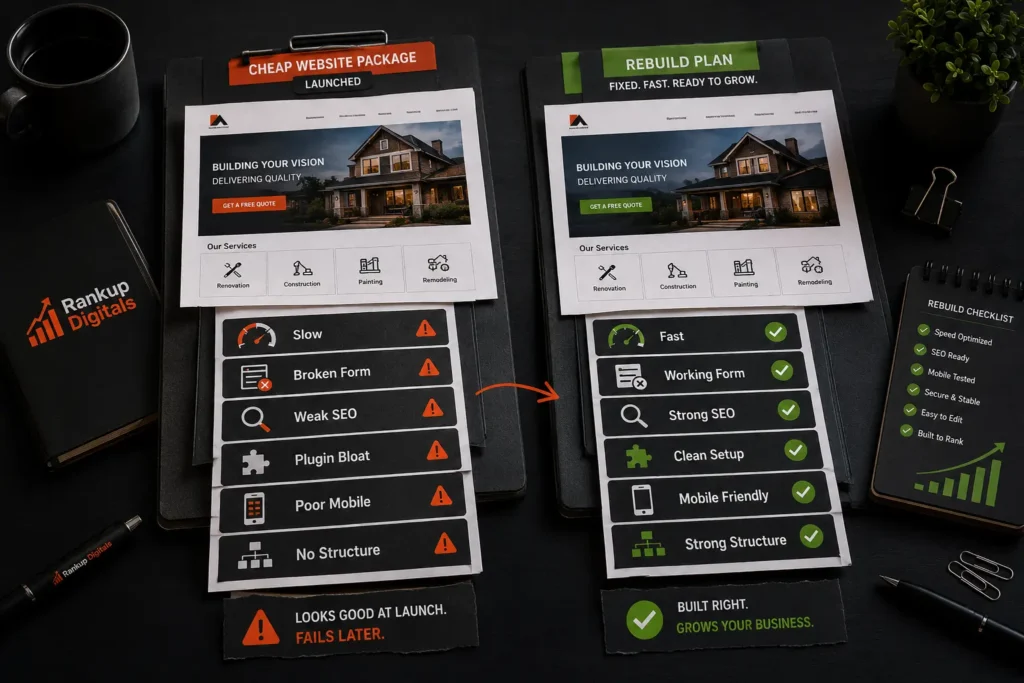
Speed. A $300 package almost always uses a free theme bloated with page builders, sliders, and demo content nobody bothered to remove. The site loads in five seconds on mobile. Core Web Vitals score sits in the red. Conversions die before the visitor even reads the offer.
Mobile experience. “Responsive” is not the same as usable. Buttons too small to tap. Text overlapping images. Sticky banners blocking the call button. Google moved to mobile-first indexing years ago, which means the mobile version is the site as far as ranking is concerned, not a backup layout.
SEO foundation. Most cheap packages skip the boring parts: schema markup, internal linking, image alt text, indexable URLs. A site can look beautiful and still be invisible to search. I’ve audited sites a year after launch where Google had indexed two pages out of forty.
Code quality. Every “free plugin to fix it” stacked on a weak theme becomes a future problem. Plugin conflicts. Security gaps. Updates that break the homepage at 11pm on a Friday. By month six the owner is paying someone else to undo what the cheap package built.
The cost of the package isn’t really the cost. The real cost is what you spend rebuilding it eighteen months later.
What “SEO-Ready” Actually Means in a Package
Half the rebuilds I take on start with the same line. “But they told me it was SEO friendly.”
SEO friendly, as written on most package pages, usually means a plugin got installed. Box ticked, invoice sent.
Real SEO website design goes further than that. The URL structure has to make logical sense. The H1 on each page has to be the page topic, not a banner phrase the designer thought looked nice. Images need to be sized properly so the page doesn’t fail Core Web Vitals on a 4G connection. Internal links should connect related content instead of pointing everything back to the homepage. And the site has to be crawlable past the menu, which more sites fail at than you’d think.
A package can call itself SEO-ready and still launch a site Google can barely see. If the agency can’t tell you specifically what they did for search beyond “we installed the plugin,” they didn’t do anything.
Different Businesses Need Different Website Packages
Most agencies skip this part. They quote a flat package and swap the homepage colors. That’s wallpaper, not design.
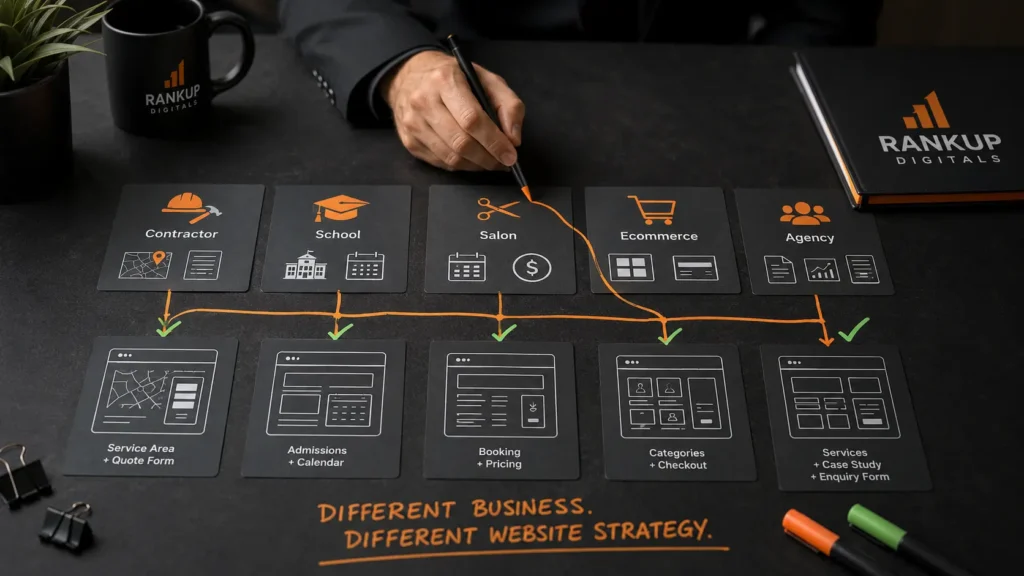
A contractor website should be built around service areas and quote forms. Project photos. Local pages for each town or zip code the business covers. The work behind that comes from real WordPress development, not a drag-and-drop builder churning out the same template for every client.
Schools are different. Parents land on the site for admissions deadlines, fee structures, the holiday calendar, sometimes a phone number for a teacher. Clarity matters more than visual polish here. A beautiful school site that buries the admissions form three clicks deep is failing the actual users.
Salon and parlor sites live on the booking button. Services with prices upfront. A real gallery, not stock photos. Google Maps embedded so walk-ins can find the place. Most salon website design packages skip the booking flow entirely and just shove a phone number in the header.
Ecommerce is its own world. Categories that make sense. A checkout that doesn’t lose people at the address field. Speed that doesn’t kill the cart. Some industries need extra care too, like a clinic site that needs proper privacy handling and an appointment flow that doesn’t break.
Agency and service businesses, which is most of who I work with, need clean service pages, real case studies, and an enquiry form that captures enough info to qualify the lead. Without those three, every visit is a coin flip.
The package isn’t really the package. It’s whether the agency thought about the business before they thought about the design.
A Quick Look at What Different Tiers Actually Get You
The pricing question comes up in almost every first call. Here’s roughly what sits behind the numbers most agencies quote.
| Package Tier | Typical Range | What’s Usually Included | Best Fit For |
| Cheap / Template | $200 to $500 | Pre-built theme, 3-5 pages, plugin-based SEO, no speed work, locked editing | Hobby sites, side projects |
| Mid / Custom | $1,000 to $3,000 | Custom layout, proper on-page SEO, real speed work, mobile testing, owner editing access | Small business website design, local services |
| Premium / Full Build | $4,000+ | Custom theme code, full schema, performance engineering, conversion-led design | Ecommerce, agencies, established brands |
These ranges move depending on country, industry, and how complex the build needs to be. A serious WordPress website package for a US-based service business usually sits in the mid range. Custom ecommerce runs higher because checkout, inventory, and integrations need real engineering, not plugin stacking.
Before paying any deposit, get a few answers in writing. What’s actually included, and what’s billed separately. Hosting, content writing, ongoing SEO services, and maintenance usually fall into that second bucket. Ask who owns the site and the code after launch. Ask whether the build is custom or template-based, and how speed and mobile get tested before delivery. If the agency can’t answer those clearly, the package isn’t ready to be sold.
A website isn’t a one-time purchase. It’s a long-term business asset, and a good package pays for itself in leads, organic search traffic, and the rebuilding cost you don’t have to swallow eighteen months later. A bad one keeps showing up as a recurring problem on your calendar.
If you’re shopping for your first business website, or the one you have stopped pulling its weight, our website redesign services can help you rebuild it around speed, structure, search visibility, and better lead flow. Start a project with us. We’ll walk through what your business actually needs before talking numbers.
Questions That Come Up Before Signing
How long does a business website build usually take?
A simple 5-page WordPress build lands in two to four weeks when the content is ready. Custom ecommerce or larger service sites run six to ten weeks. Delays almost always come from missing content on the client side, not from the build itself.
Should I pay monthly for a website or buy the package outright?
Monthly plans look cheaper but you don’t actually own anything. The site, hosting, and edit access all sit behind the agency’s account. Buying outright costs more upfront, but you keep the asset and the freedom to switch providers later without losing the work.
Do I own the website and the code after launch?
You should. A proper package hands over full design files, WordPress admin access, hosting credentials, and code ownership. If anything stays behind with the agency, ask why before you sign the deposit invoice.
