

A business owner sent me a Google Ads account last month. Three months old, $4,200 spent, two leads. The campaign was bidding on “marketing services” as a broad match keyword. Search terms triggering the ads included “free marketing courses,” “marketing definition,” and “marketing degree.” None of those were ever going to convert into a paying client. The account didn’t need optimization. It needed someone to actually open the search terms report.
That’s a normal week in this work. A google ads marketing agency exists because most owners don’t have the time or the technical depth to watch what’s actually happening inside the ad account, even when the budget is real money on the line every day.
Here’s what the role actually looks like when an agency does it properly.
What a Real Google Ads Marketing Agency Does Day to Day

The work splits roughly into three rhythms, and most owners only see the third one.Daily account hygiene comes first. Checking what conversions came in overnight, pausing keywords or audiences that burned budget without results, adding negatives from the search terms report. The boring stuff that compounds. A retainer-worth agency touches a live account three or four times a week, sometimes daily on higher-spend accounts where every paused dollar matters.
Weekly work shifts into testing. Ad copy variations, bid adjustments on the keywords actually showing profitable conversions, expanding what’s working, killing what isn’t. Agencies I respect don’t change everything at once. They isolate one variable per test, otherwise the data turns into noise quickly.
Monthly is when strategy gets reviewed. ROAS by campaign, conversion rate broken down by device and audience type, the budget split between Search, Performance Max, Display, and Shopping for the next thirty days. Owner conversations happen here too. Numbers translated into a decision: where to push harder, where to pull back, what to test next.
The piece most owners never see is the search terms report. A new account spending $3,000 a month can have hundreds of unique search queries triggering ads inside the first month alone. In practice, a meaningful chunk of those queries aren’t buying intent at all, even on tight keyword match types. A google ads management workflow that’s actually working includes weekly negative keyword cleanup to cut that waste before it accumulates.
That’s why a fresh account often improves in cost per lead just from cleanup, before any real “optimization” work has even begun.
How They Build Campaigns That Actually Bring Leads
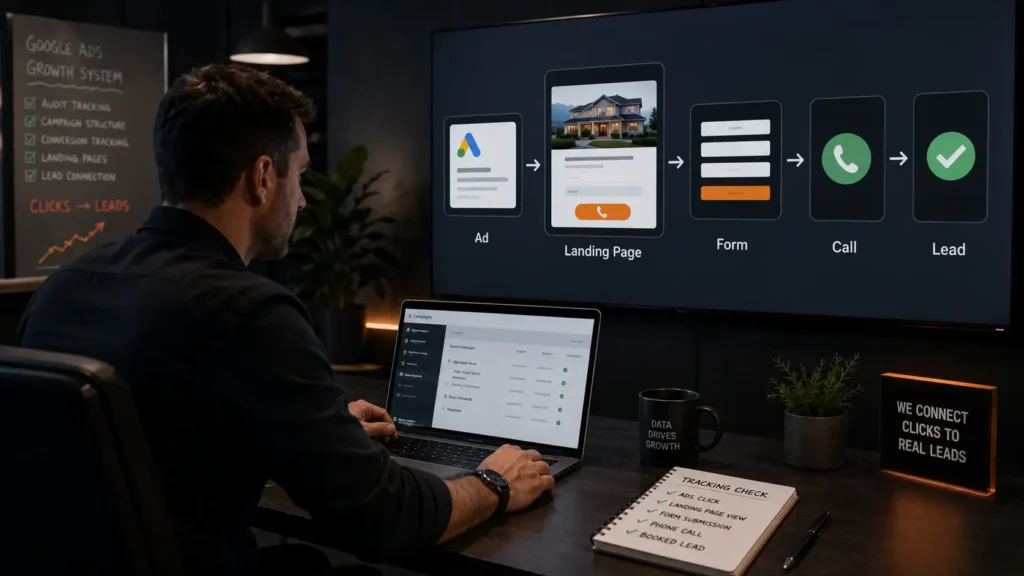
Before any campaigns get built, conversion tracking gets audited. If the website isn’t sending real conversion events back to Google Ads, every bidding decision the algorithm makes after that is just guessing. I’ve taken over accounts where tracking was set up wrong from day one. The “leads” Google was optimizing for were footer clicks, not form submissions. Nothing about the campaigns themselves was broken. The data underneath them was.
Account structure gets the next look. Most owner-built accounts group campaigns by service or product, which isn’t how Google Ads works best. Campaigns should be split by search intent and conversion behavior. A high-intent campaign with strict match types sits separately from a broader awareness campaign running Performance Max. Mixing them under one budget pool muddies the optimization signal entirely.
Campaign type selection comes next, and it depends entirely on the business model.
| Campaign Type | Best For | What a Good Agency Watches |
|---|---|---|
| Search Campaigns | High-intent leads from people already searching for a service or product | Search terms, match types, negative keywords, cost per lead, and conversion quality |
| Performance Max | Wider reach across Google Search, YouTube, Display, Gmail, Maps, and Shopping placements | Conversion tracking, audience signals, asset quality, wasted placements, and whether the campaign is getting real leads |
| Display Campaigns | Retargeting visitors or building awareness before they are ready to buy | Placement quality, low-intent clicks, frequency, audience targeting, and budget waste |
| Shopping Campaigns | Ecommerce stores selling physical products | Product feed quality, pricing, margins, search terms, and return on ad spend |
The ad copy and landing page connection is the next layer most accounts get wrong. The ad promises one thing, the landing page delivers something different, or sends traffic to a generic homepage instead of a focused page. According to WordStream’s Google Ads benchmarks, average landing page conversion rates across industries hover around 4 to 6 percent. Sites with focused, ad-specific landing pages routinely double that number.
Testing is the layer that never stops. New ad copy weekly, audience adjustments based on conversion data, scaling what works and killing what doesn’t. The slow weekly grind of solid ad marketing is what turns wasted spend into trackable revenue.
When to Stop Running Ads Yourself and Bring One In
The math usually settles this. According to Agency Analytics’ 2026 PPC management pricing guide, agencies typically charge between 10 and 20 percent of monthly ad spend, with flat retainers ranging from $500 to $3,000 for freelancers and $2,000 to $10,000+ for full agencies. The threshold most owners cross is around $2,000 to $3,000 monthly in ad spend. Below that, the management fee takes too big a bite of the budget, and a careful freelancer or self-managed approach often makes more sense than a full agency.
Above that line, the picture flips. A 15 percent fee on $5,000 of ad spend is $750. If proper management cuts cost per lead by even 25 percent through cleanup, structure, and continuous testing, the fee pays for itself inside the first month. That’s the calculation that actually matters.
Three signals usually mean it’s time. Ad spend climbs every quarter but conversions stay flat. The account has Performance Max running with no exclusion lists, or Search campaigns with broad match and no negatives. Or the owner stopped opening the account two weeks ago because everything felt overwhelming and the dashboard stopped making sense.
A good google ads marketing agency at that stage isn’t just optimization, it’s relief. The owner gets their week back. The budget starts producing trackable revenue instead of mystery clicks.
Paid media also lives downstream of bigger marketing decisions, which is why a strong digital marketing strategist view of which channels actually fit the business shapes whether Google Ads should be the main play or one piece of a larger system.
If your Google Ads account is burning budget without clear ROAS, or you’re starting fresh and want it built properly from the first campaign, start a project with us and we’ll audit what’s there before suggesting any spend.
