

Marketers waste 26% of their total marketing budget, according to Entrepreneur reporting from late 2025. For a business running $20,000 a month in marketing, that works out to roughly $62,400 a year disappearing into campaigns that fail to pay back.
Most of that waste does not come from bad specialists. It comes from disconnected work, where the ads team is pushing one offer while the content team builds for a different audience and social runs its own playbook entirely. Three competent operators with no shared plan.
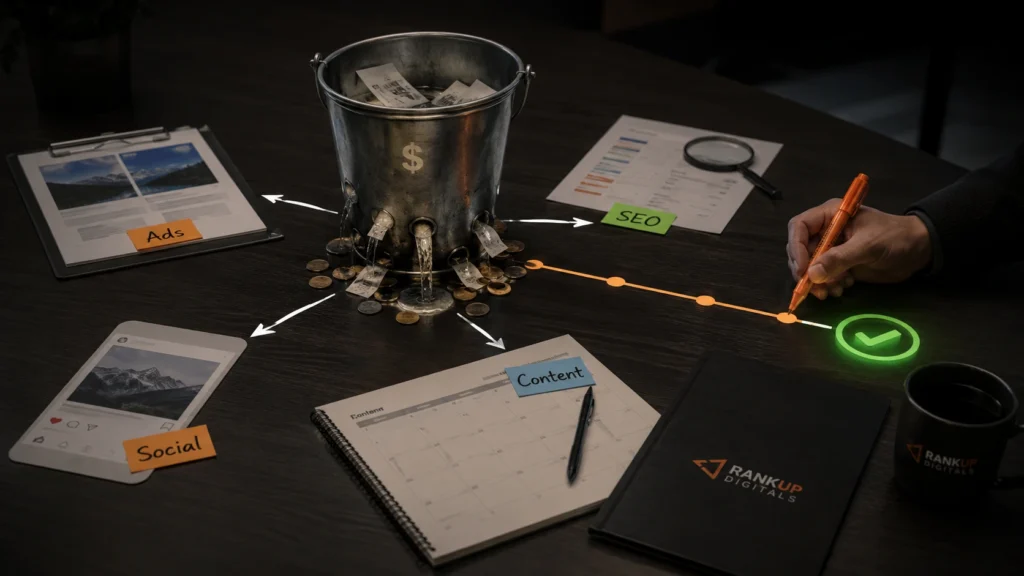
That gap is what a digital marketing strategist gets paid to close. They do not ship the campaigns or write the ad copy. They make sure every channel, every campaign, and every piece of content is pulling toward the same business outcome, with measurement that connects back to revenue.
What the role actually involves
The job sits between business objectives and the people running campaigns. It is not about writing ad copy or shipping landing pages. It is about deciding what to ship, why, and how the channels are supposed to feed each other.
A normal week? Mostly audits. GA4 deep dives, Search Console anomaly checks, Meta Ads Manager attribution comparisons, the occasional Looker Studio rebuild because somebody’s dashboard is lying to leadership. A strategist also reads the boring stuff. Google Search Central release notes. Meta policy updates. Whatever changed in iOS attribution last quarter. The U.S. Bureau of Labor Statistics overview describes marketing managers as planning campaigns across channels, which is part of it but misses the editorial side.
The rest of the week is unglamorous. Saying no to campaign ideas that do not fit the funnel stage. Pushing back on founders who want to chase the latest TikTok trend. Telling a $12k/month agency their reporting deck is mostly vanity numbers.
Strategist vs specialist vs manager
People confuse these three roles constantly. It costs them money.
A specialist owns one channel. An SEO specialist optimises pages and builds backlinks. A PPC specialist runs ads. They go deep, and that depth is real.
A manager runs the team. Approvals, deadlines, status meetings, vendor coordination.
A strategist owns the direction. Picks the channels. Sets the goals. Designs the funnel. Builds the measurement stack. Connects every campaign back to revenue or pipeline.
Hire a specialist when you already know which channel is the lever. A strategist makes sense when you do not know, or when your existing specialists are starting to step on each other’s work. That coordination gap is also what a full service digital marketing agency is supposed to solve at the team level, when channels stop talking to each other entirely.

What separates a real strategist from packaging
The skill stack is not glamorous. Here is what it actually looks like in practice.
| Skill area | What it covers |
|---|---|
| Analytics literacy | Reading GA4, Search Console, ad platform data, and tying it back to revenue or pipeline |
| Channel knowledge | Knowing what SEO can and cannot do for a 6-week B2B sales cycle vs a 24-hour DTC purchase |
| Audience research | Buyer interviews, support ticket mining, churn surveys, not only SparkToro reports |
| Funnel design | Mapping awareness, consideration, and decision stages with named assets at every step |
| Budget allocation | Spend distribution based on CAC payback math, not gut feel |
| Measurement | Tracking that survives iOS attribution changes, GA4 quirks, and ad blocker traffic |
What ties all of this together is judgment. The best strategist I worked with on a mid-size ecommerce account did not write the best copy. Her landing pages were not pretty. But she knew which two metrics actually moved the P&L and which fifteen were noise. That clarity saved the account a planned $48k Q4 paid push they were about to waste on a stale audience.
Bigger picture, this role overlaps heavily with SEO services when organic is the growth lever, and with ad marketing when paid is doing the heavy lifting. The good ones run both without religion.
When to hire one
You probably do not need a strategist on day one. If you are hunting your first 10 customers, a specialist or solo execution covers most of the ground.
The pain usually shows up later. Common signals include:
- Ad spend climbs every quarter while leads stay flat
- Two or more agencies delivering work that does not reference each other
- Reports full of impressions, reach, and “engagement” but no revenue line
- Campaigns launch hot and die in 4 weeks because nobody owns the follow-up
- Your team has grown but there is no shared 90-day plan
Ecommerce brands tend to hit this wall around $80k to $120k in monthly revenue, when paid acquisition is no longer covered by organic word of mouth. Service businesses feel it once referrals plateau, usually around year three, especially in local digital marketing where the system has to take over the work that word-of-mouth used to do for free. SaaS hits it as soon as the founder stops being the main person giving demos.
Social is another flashing light. Big followers, low conversions, no campaign integration. If that sounds familiar, social media marketing without strategy is the problem. The reach is fine. The plan is missing.

How to spot a good one before you sign anything
The first call is where you can read them.
A real strategist asks more than they pitch. They want your CAC, your gross margin, your sales cycle, your churn rate. They want to see your last 90 days of GA4 before suggesting anything. If paid campaigns are already running, they should also look at the account through a proper Google Ads audit before telling you to increase spend. If someone walks into a kickoff meeting with a channel plan already drafted, they are not strategising. They are selling templates.
Other green flags? Comfort with both organic and paid. An opinion on attribution that goes past last-click. The ability to explain a strategic decision in revenue terms rather than marketing jargon.
Red flags are easier to spot. Guaranteed rankings. One-channel evangelism, the “everything-is-fixed-by-TikTok” energy. Slide decks heavy on visuals and light on numbers. Promises about ranking on “page one” without asking which keywords or what the search intent looks like.
Final word
A digital marketing strategist earns their fee by making the right decisions, not many decisions. Most of the value sits in campaigns that never get launched.
If your marketing budget is starting to feel like a leaky bucket and your team is bigger than your plan, that is usually the right moment to bring strategy in. The start project page is the easiest way to begin that conversation.
FAQs
Is a digital marketing strategist the same as a consultant?
Close, but not identical. Consultants usually deliver a plan and exit. Strategists tend to stay through execution and own the measurement loop. The strategist sees what the plan looks like once it survives contact with an actual market.
How much does a digital marketing strategist cost?
Rates sit on a wide spectrum. Independent strategists in 2025 typically charged $90 to $275 per hour depending on vertical and years of experience. Agency retainers that include strategic work usually run $2,500 to $9,000 a month. Fractional CMO engagements sit higher, often $8,000 to $15,000 a month, because they cover team leadership on top of strategy. Clutch and Sortlist publish updated agency pricing benchmarks each quarter for anyone wanting current numbers.
Can a small business afford one?
Most small businesses access strategy through fractional or retainer engagements rather than full-time hires. Many start with focused small business SEO services and layer in strategic oversight as the marketing budget matures, rather than committing to a senior strategist on day one. The math tends to work out. A fractional strategist at 10 to 15 hours a month delivers more direction than a mid-level full-time hire, at roughly a third of the loaded cost.
