Last summer a roofing contractor sent me his Search Console dashboard. All green arrows. Impressions up. Clicks up. Local pack appearances up too. His monthly phone log told a different story. Same fifteen calls he was getting before any “marketing” started. The traffic was real. The leads were not.
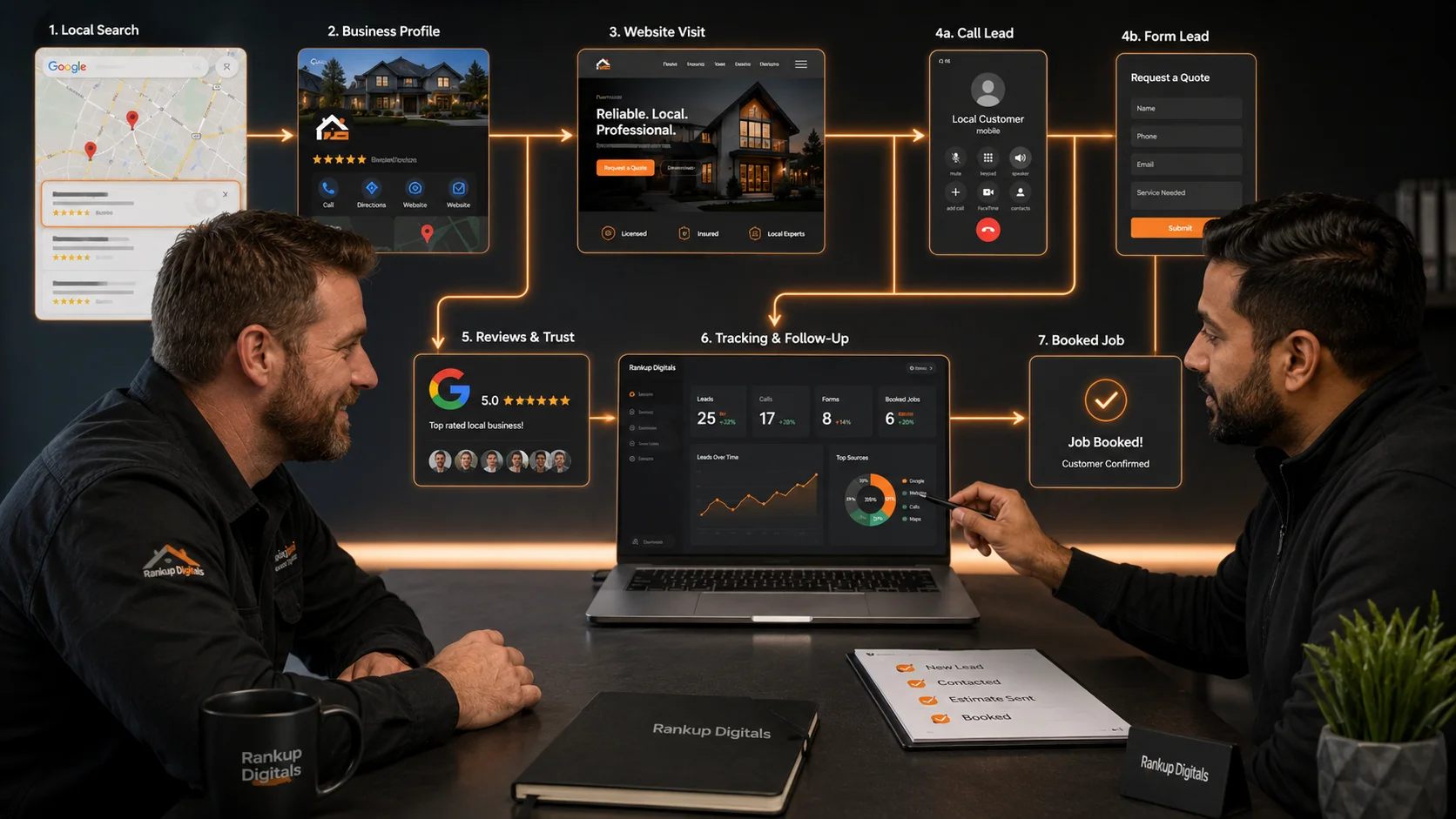
This is the part of local digital marketing nobody talks about much. Rankings without ringing phones means the system is broken somewhere between the search result and the customer’s decision to call. Most of the time it isn’t the SEO. It’s everything that happens after the click.
Here’s what local digital marketing actually has to deliver if the goal is leads, not impressions.
Why Local Traffic Doesn’t Equal Local Leads
The disconnect usually shows up in three places. None of them is the SEO itself.
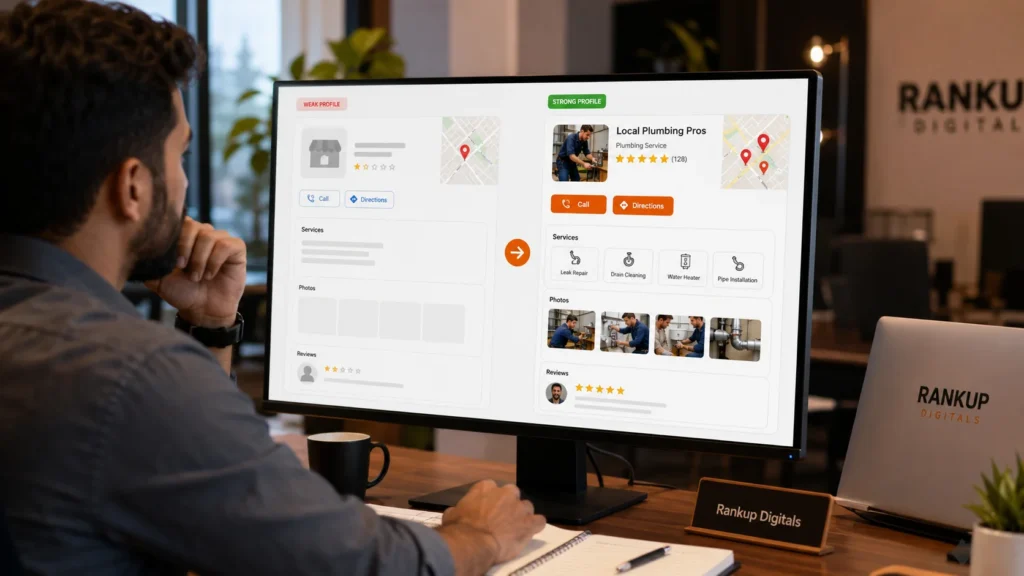
The Google Business Profile is the first one. Wrong category selected, half the services missing, no recent posts, and a phone number that doesn’t match the website. Searchers see the profile, decide the business looks half-asleep, and scroll to the next listing in the map pack.
Then the website. Visitor lands on a homepage that looks generic, doesn’t say which towns the business actually covers, and buries the phone number in the footer. Local intent gets lost in five seconds, gone.
The last break is after a form gets filled. No call tracking. No lead notification system. The owner finds the form submission three days later, sitting in a spam folder, while the customer already booked someone else.
Rankings can be top three in the map pack and the business still loses every lead in those three handoffs.
What Local Digital Marketing Actually Includes
What works is a connected system. Six pieces that hand the work to each other, not six campaigns running in parallel.
A Google Business Profile that’s complete and updated weekly. A website with real service area pages for each town or zip code being targeted. Local SEO work done on-page and across directories. A steady review-request flow that doesn’t feel forced. Paid ads pointed at high-intent local searches, not broad terms that burn budget on the wrong clicks. And conversion tracking on calls, forms, and direction clicks so the owner actually knows what’s bringing in jobs.
Drop one piece and the system limps. Skip GBP optimization and the map pack ignores you. Skip reviews and the trust signal disappears. Skip tracking and the marketing budget bleeds without anyone knowing where.
A digital marketing company for small business owners that pitches just one piece of this, “we’ll get you ranked” or “we’ll run your ads,” isn’t doing local digital marketing. They’re running one channel and hoping the rest takes care of itself.
The Google Business Profile Most Businesses Get Wrong
The GBP isn’t a directory listing. It’s the first impression for almost every local search. According to Whitespark’s Local Search Ranking Factors survey, the primary category alone is one of the strongest drivers of local pack visibility, ahead of most on-page work.
What actually moves the needle:
The primary category has to match what the business does most. A pizza shop that picks “Restaurant” instead of “Pizza restaurant” leaves visibility on the table. Secondary categories should cover real services the business offers, not aspirational ones.
Services need their own listings with short descriptions. Just “Roofing” doesn’t cut it. List “Asphalt shingle installation,” “Metal roof repair,” “Leak inspection,” each with one short line of detail.
Photos need to be recent, real, and geotagged. Phone shots of actual jobs beat stock photography every time. Google reads these images and the location data attached to them.
Posts go out weekly. Updates, offers, a photo from a recent job. A profile sitting silent for eight months reads as inactive even when the business is fully booked.
How an owner responds to a one-star review tells future customers more than the star count itself.
Service Area Pages and What Google Actually Counts
Most local businesses get service area pages wrong the same way. They duplicate one template, swap the town name, and publish ten pages that say almost the same thing. Google notices. So do the customers.
Here’s the gap between what most agencies build and what actually ranks and converts.
| Common Mistake | What Works Instead |
| Same template duplicated for every town, only the city name swapped | Each page genuinely about that specific town, with local landmarks, routes, or service notes |
| Generic stock photos on every location page | Photos from real jobs done in that area, geotagged where possible |
| No mention of nearby zip codes or neighborhoods | Real service area definition with local zip codes and neighborhood names |
| Phone number buried below the fold | Click-to-call button at the top, with the number also in the header |
| No reviews from customers in that area | One or two local customer reviews surfaced on the page |
A page that genuinely belongs to one town earns more local map pack appearances than a thin page that says “We serve [town] and the surrounding area” five times in different font sizes. This is where web design and digital marketing actually meet. The design signals local relevance in five seconds, and the marketing points the right searcher at it. Solid small business SEO services almost always start with rebuilding the service area pages before touching anything else.
The Tracking Layer Most Local Businesses Skip
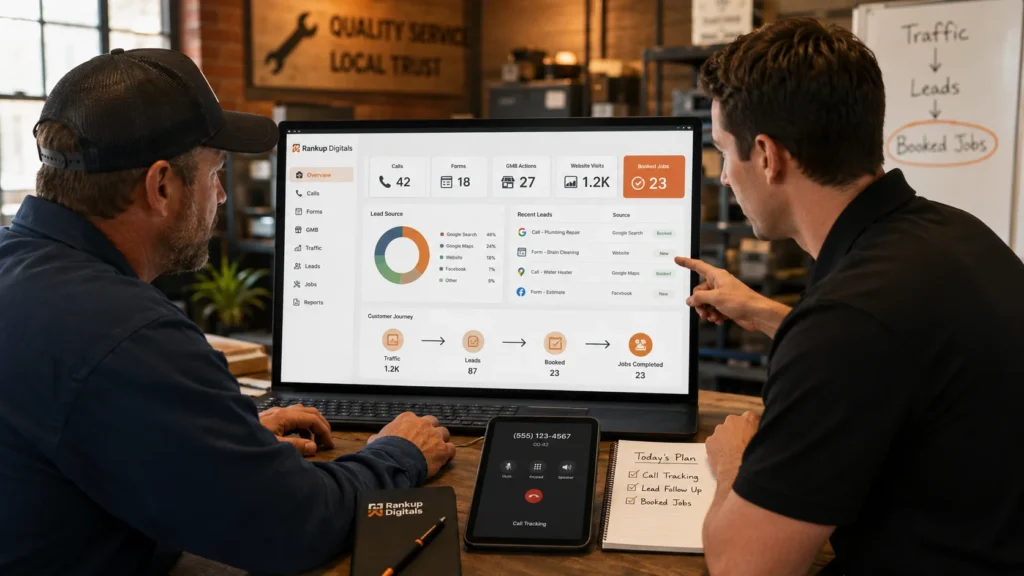
The biggest blind spot for most local businesses is the tracking layer. Calls aren’t tracked back to source. Form submissions go to a personal email that the owner checks once a day. Google Business Profile insights sit unread. The marketing budget keeps spending without a clear answer to a simple question: which channel actually brought in last week’s jobs?
Set up a call tracking number on the website and a separate one on the GBP. Form submissions should push into a CRM, not into a personal inbox where they get lost. Check GBP insights weekly, the call count, direction clicks, and website visits, then compare those to the actual jobs booked that month.
This is what separates a full service digital marketing agency from a vendor running one channel. The six pieces have to work together, and the tracking has to tie them back to real revenue. Without that, the marketing budget is just guessing.
For local businesses, the win isn’t ranking higher. It’s owning every step from search to booked job. A connected system brings better leads. Another campaign added on top usually doesn’t.
If your local digital marketing is producing traffic without phone calls, or your paid ads are running without proper tracking behind them, start a project with us and we’ll walk through where the leaks are before anyone touches a budget.
Questions Local Business Owners Usually Ask
Do I need a website if my Google Business Profile is fully optimized?
Yes. The GBP is the entry point, but customers click through to a website to verify trust and see services in detail. A business without a real site loses leads to competitors who have one.
Why is my business ranking locally but the phone still isn’t ringing?
Usually one of three things. The GBP looks inactive with outdated photos. The website doesn’t make local intent obvious or buries the contact info. Or no tracking is set up, so calls happen but the owner doesn’t know where they’re coming from.
Should I start with local SEO or local paid ads first?
Depends on how fast leads are needed. Paid ads can produce calls within two weeks if set up properly. Local SEO usually takes three to six months to show real movement. Most local businesses run both, with ads carrying the early load while SEO compounds in the background.
