

A business owner sent me a Google Ads account last month. Three months old, $4,200 spent, two leads. The campaign was bidding on “marketing services” as a broad match keyword. Search terms triggering the ads included “free marketing courses,” “marketing definition,” and “marketing degree.” None of those searchers was ever going to become a paying client. The account didn’t need optimization. It needed someone to open the search terms report.
That’s a normal week in this work. A google ads marketing agency exists because most owners don’t have the time or the technical depth to watch what happens inside the ad account, even when real money is on the line every day.
What a google ads marketing agency does day to day

The work splits into three rhythms, and most owners only see the third one.
Daily account hygiene
This means checking which conversions came in overnight, pausing keywords or audiences that burned budget, and adding negatives from the search terms report. It’s boring work that compounds. An agency worth a retainer touches a live account three or four times a week, and sometimes daily on higher-spend accounts.
Weekly testing
Weekly work shifts into testing: ad copy variations, bid adjustments on keywords showing profitable conversions, expanding what works and cutting what doesn’t. Good agencies isolate one variable per test, otherwise the data turns into noise.
Monthly strategy review
Monthly, the agency reviews ROAS by campaign, conversion rate by device and audience type, and the budget split between Search, Performance Max, Display, and Shopping. The owner conversation happens here too, with numbers turned into a decision: where to push harder, where to pull back, what to test next.
The search terms report
This is the piece most owners never open. A new account spending $3,000 a month can have hundreds of unique search queries triggering ads in the first month alone, and a meaningful share have no buying intent. Weekly negative keyword cleanup cuts that waste before it piles up.
That’s why a fresh account often improves its cost per lead from cleanup alone. If you suspect your own account has this problem, a Google Ads audit is the fastest way to see it before you add more budget.
How an agency builds campaigns that bring leads
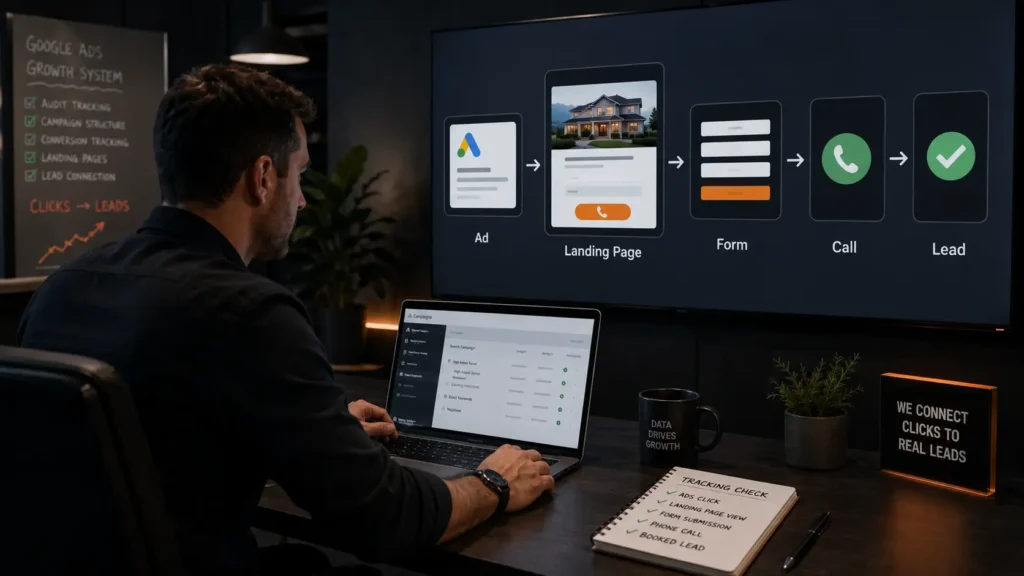
Before any campaign gets built, conversion tracking gets audited. If the website isn’t sending real conversion events back to Google Ads, every bidding decision the algorithm makes afterward is a guess. I’ve taken over accounts where the “leads” Google was optimizing for were footer clicks, not form submissions. The campaigns were fine. The data underneath them was broken. The Google Ads Help center explains how conversion actions are set up, and Google Analytics Help covers site-side measurement.
Account structure gets the next look. Campaigns should be split by search intent and conversion behavior, not just by service. A high-intent campaign with strict match types sits apart from a broader awareness campaign running Performance Max. Mixing them under one budget pool muddies the signal the algorithm learns from.
Campaign type selection comes after that, and it depends on the business model.
| Campaign type | Best for | What a good agency watches |
|---|---|---|
| Search | High-intent leads from people already searching for a service or product | Search terms, match types, negative keywords, cost per lead, and conversion quality |
| Performance Max | Wider reach across Google Search, YouTube, Display, Gmail, Maps, and Shopping placements | Conversion tracking, audience signals, asset quality, wasted placements, and whether the campaign brings real leads |
| Display | Retargeting visitors or building awareness before people are ready to buy | Placement quality, low-intent clicks, frequency, audience targeting, and budget waste |
| Shopping | Ecommerce stores selling physical products | Product feed quality, pricing, margins, search terms, and return on ad spend |
The ad and the landing page have to match
Many accounts get this wrong. The ad promises one thing, and the landing page delivers something else or sends traffic to a generic homepage. WordStream’s Google Ads benchmarks put average landing page conversion rates across industries at around 4 to 6 percent. Our guide to landing page optimization shows what to fix before spending more, and solid business website design keeps the contact form easy to find.
Testing never stops
New ad copy weekly, audience adjustments based on conversion data, scaling what works and cutting what doesn’t. This slow grind of good PPC advertising services turns wasted spend into trackable revenue. You can see how it looks in practice in our skincare paid ads case study.
What it costs and when to hand over the account
According to Agency Analytics’ 2026 PPC management pricing guide, these are the typical ranges. Your ad spend is separate and goes straight to Google.
| Pricing model | Typical range |
|---|---|
| Percentage of monthly ad spend | 10 to 20 percent |
| Freelancer flat retainer | $500 to $3,000 |
| Full agency flat retainer | $2,000 to $10,000+ |
The threshold most owners cross is around $2,000 to $3,000 in monthly ad spend. Below that, the fee takes too big a bite of the budget, and a careful freelancer or a self-managed approach often makes more sense than a full agency.
Above that line, the picture changes. A 15 percent fee on $5,000 of ad spend is $750. Say proper management cut your cost per lead by 25 percent through cleanup, structure, and steady testing. The fee would pay for itself inside the first month. That’s an example, not a promise, but it’s the calculation worth running with your own numbers.
Three signals usually mean it’s time:
- Ad spend climbs every quarter but conversions stay flat.
- Performance Max is running with no exclusion lists, or Search campaigns use broad match with no negatives.
- You stopped opening the account two weeks ago because the dashboard stopped making sense.
At that stage, a good agency brings relief as much as optimization. The owner gets their week back, and the budget starts producing trackable revenue instead of mystery clicks.
What to ask before you hire
Not every agency works the same way, so a few direct questions save pain later.

- Who owns the account? It should be yours, with the agency added as a manager.
- How is conversion tracking verified? You want to hear about form submissions and calls, not clicks.
- What does reporting show? Cost per lead and revenue matter more than impressions.
Industry knowledge counts too. A clinic runs ads very differently from a store, which is why we wrote a separate guide on Google Ads doctors need. Paid media also sits downstream of bigger decisions, so a digital marketing strategist can tell you whether Google Ads should be the main play or one piece of a larger system.
Ads and organic search work best together. Many owners pair ads with small business SEO so traffic doesn’t stop the day the budget does. Our full service agency overview shows how that fits together, and local digital marketing is worth a look if you serve a specific area.
Frequently asked questions
What does a Google Ads marketing agency do?
It sets up, runs, and improves your paid campaigns on Google. That includes conversion tracking, campaign structure, ad copy, bids, negative keywords, and regular reporting. The goal is to turn ad spend into leads or sales you can measure.
How much does a Google Ads agency charge?
According to Agency Analytics’ 2026 pricing guide, agencies typically charge 10 to 20 percent of monthly ad spend. Flat retainers run $500 to $3,000 for freelancers and $2,000 to $10,000+ for full agencies. Your ad budget is paid to Google on top of that.
Is my ad budget too small for an agency?
Below roughly $2,000 to $3,000 a month in ad spend, the fee takes too much of the budget for many owners. A freelancer or self-management is often a better fit there. Above that, professional management is easier to justify.
Should I own my Google Ads account?
Yes. The account holds your data, history, and conversion tracking. Ask for it to be created under your business, with the agency given manager access.
How do I know if my account is wasting money?
Open the search terms report and read what people typed before clicking. If you see free, definition, or course searches unrelated to your offer, you’re paying for clicks that won’t convert. Google’s own Google Ads site explains the platform basics.
Next step
If your Google Ads account is burning budget without clear ROAS, or you’re starting fresh and want it built properly from the first campaign, book a free marketing consultation and we’ll audit what’s there before suggesting any spend. You can also contact us directly with questions.
