

Picture a bakery owner who launches a new website on a Monday. By Wednesday she has typed her shop’s name and “best bakery near me” into Google again and again, and the site is nowhere to be found. She starts to wonder if the whole thing was a waste of money.
Nothing is wrong with her site. It is simply early, and early looks a lot like failure when you are watching closely.
How long does SEO take to show results?
SEO usually takes months, not days or weeks, to bring steady results. Small movements can show up sooner, such as pages getting indexed or starting to appear for low-competition searches. Meaningful traffic and leads normally take longer, and nobody can honestly give you an exact date.
Google’s own SEO starter guide is a good place to see what the basics involve. Be wary of anyone who promises a ranking by a certain week. Rankings depend on your competitors, your site and how well your pages answer what people search for.
The more useful question is what decides how fast you move. That is where the real differences come from.
What happens in the first few weeks
The early stage is mostly about getting found by Google at all. Your pages have to be crawled, understood and added to the index before they can rank for anything.
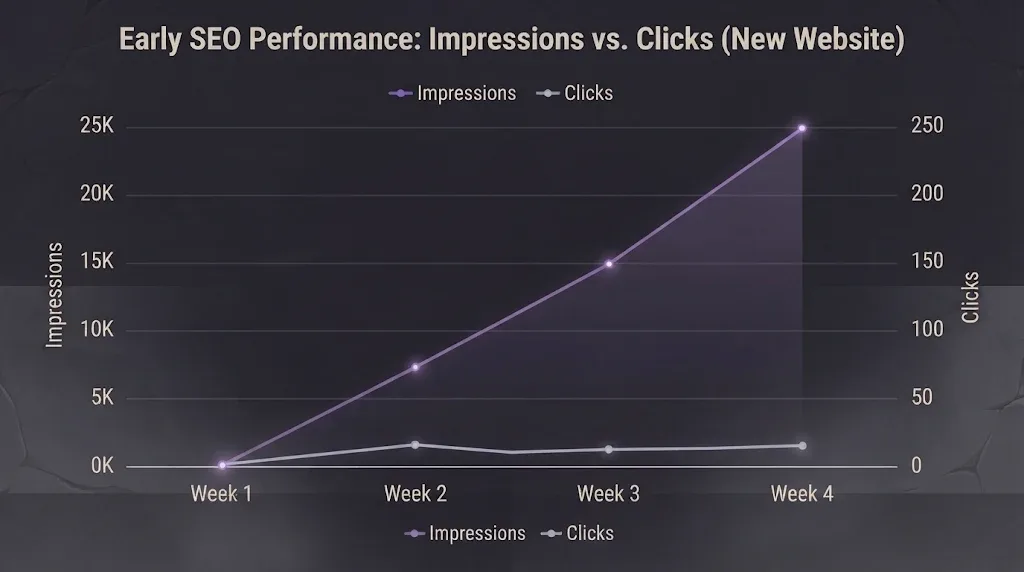
You can help this along. Submit a sitemap, make sure important pages are not blocked, and link new pages from pages that are already known. Google explains how this works in its sitemaps overview.
Do not worry about crawl budget at this stage. It mainly matters for very large sites, roughly a million pages, or 10,000 or more pages that change every day. A typical business website is far below that, so slow results are almost never caused by it.
During these weeks, you may see impressions rise in Google Search Console before any clicks arrive. That is a good sign, even though it does not feel like one.
What decides your timeline
Two businesses can start SEO on the same day and see very different results. These are the factors that tend to matter most.
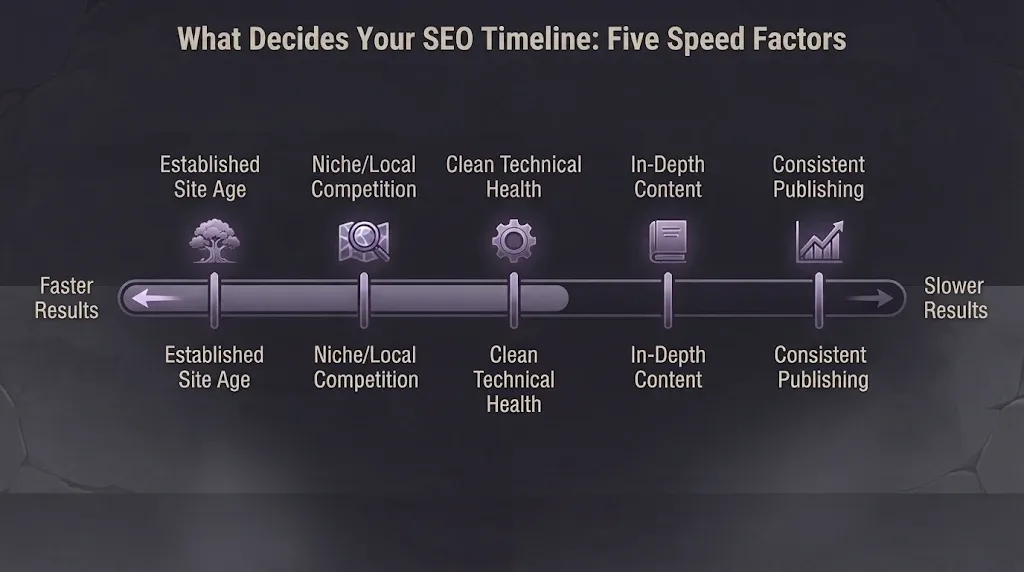
| Factor | Usually moves faster | Usually moves slower |
|---|---|---|
| Site age and history | Established site with existing content and links | Brand-new domain with no history |
| Competition | Specific, local or niche searches | Broad searches dominated by big brands |
| Technical health | Clean structure, fast pages, no crawl errors | Broken pages, slow loading, messy redirects |
| Content | Pages that answer a clear question well | Thin pages or pages that overlap each other |
| Consistency | Steady publishing and fixing over time | Bursts of work followed by long gaps |
Notice that most of these are things you can influence. The next section covers the one that surprises people most, which is how much existing problems can hold a site back.
Why some sites wait longer than they should
A site can have good content and still sit still because of problems underneath. Fixing those is often the first job, and it comes before any new content pays off.
Technical problems
Slow pages, broken links and confusing site structure all get in the way. Core Web Vitals, which are LCP, INP and CLS, are the page experience measures Google publishes. On WordPress, a heavy theme or poor hosting is a common cause, and our guide on how to speed up WordPress walks through the usual fixes.
Deleted pages are another trap. Google treats all 4xx errors except 429 the same way, so you cannot count on a 410 being handled differently from a 404. Redirecting every deleted page to the home page is usually treated as a soft 404, which does not help. Our page on the 404 error code explains how to handle these properly.
If your rankings used to be fine and then dropped, a technical SEO audit is the fastest way to find out why.
Avoidable mistakes
Sometimes the delay comes from the basics: missing page titles, duplicate pages, or content written for no one in particular. We cover the most common ones in SEO mistakes that hurt business websites. Also, Google ignores the meta keywords tag, so time spent filling it in is time wasted.
How to tell SEO is working before traffic jumps
Traffic is a lagging signal. Earlier signs tell you whether you are heading the right way.
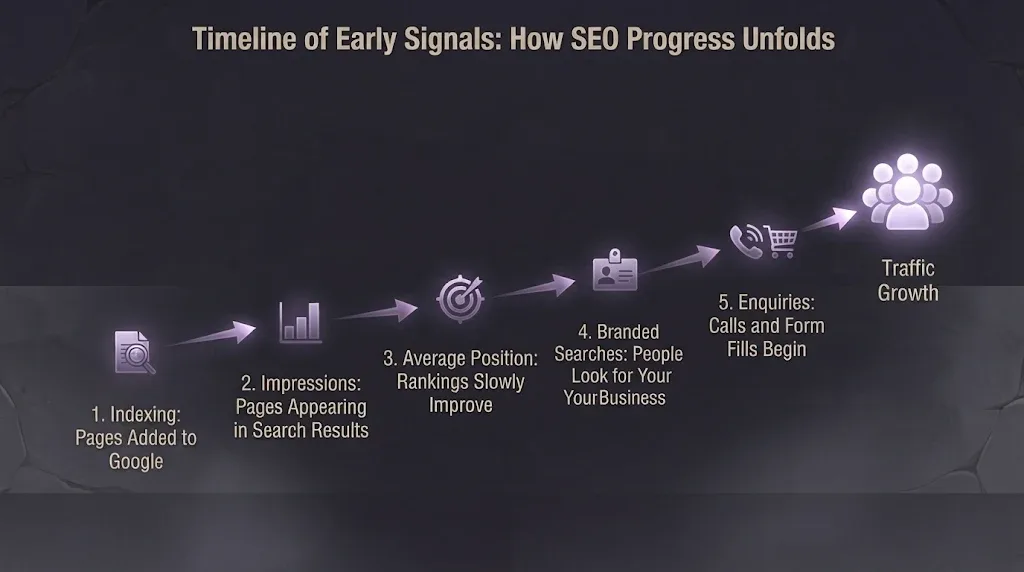
- Indexing: your key pages appear in Google and new pages get picked up.
- Impressions: your pages show up for more searches, even with few clicks.
- Average position: it slowly improves for the searches you care about.
- Branded searches: more people look for your business by name.
- Enquiries: calls and form fills from organic visitors start to appear.
Check these in Search Console once a month rather than every day. Daily checking only makes normal ups and downs feel like trouble.
Where a page sits in the results tells you something too. A page on page eight is not close to getting clicks, while a page on page two has a better chance of moving up with stronger content or better internal links.
What you can do to speed things up
You cannot force Google to move faster, but you can stop slowing yourself down. Start with the pages closest to producing business, such as service pages, then build outward.
Content is the biggest lever for most sites. Write pages that fully answer one question, and keep them useful rather than padded. Google’s guidance on helpful content is a good standard to check against. If you do not have the time to write, SEO content writing can fill that gap.
Match your effort to your market. A shop serving one city has a different path than a national brand. Businesses that serve a specific area often see progress through local digital marketing, because the competition is narrower and the searches are more specific. Smaller companies can see what a realistic plan looks like in our guide to small business SEO.
Some industries are harder than others. Fields where clients choose carefully and competition is tight, such as SEO for lawyers or real estate SEO, tend to need patience and a clear plan. The same applies to a long sales cycle where trust matters more than speed.
Frequently asked questions
Can SEO work in a few weeks?
Some early signs can appear within weeks, such as indexing and first impressions. Steady traffic and leads generally take longer. Treat any promise of fast rankings with caution.
Why am I not ranking after a few months?
Common causes are strong competition, technical problems, thin content or pages that do not match what people are searching for. A site review will usually show which one applies. Fixing the basics first tends to save time later.
Does a new website take longer than an old one?
Usually it does. A new domain has no history for Google to judge, so it has to earn trust from scratch. An older site with solid content and links has a head start, though old problems can cancel that out.
Is paid advertising faster than SEO?
Paid ads can send visitors as soon as a campaign is live, while SEO builds more slowly. The two do different jobs. Ads stop when the budget stops, and SEO work can keep paying off for longer.
What happens if I stop doing SEO?
Pages that already rank do not vanish overnight. Over time, though, competitors publish and update, and unfixed problems pile up, so results can slip. Regular upkeep protects what you have built.
Plan for months, measure along the way
SEO rewards patience, but patience works best with a plan and a few clear checkpoints. If you want help setting realistic expectations for your site and your market, take a look at our SEO services. If you would rather talk it through first, you can start a project and we will look at where your site stands today.
